
On 20 July 1944, a 36-year-old
German army officer, Col Claus Schenk Graf von Stauffenberg,
arrived at a heavily guarded complex hidden in a forest in East
Prussia. His mission was to kill Adolf Hitler.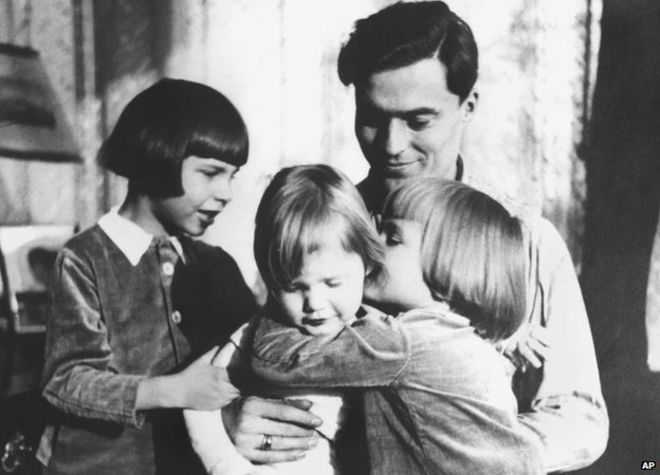
The Wolfsschanze, or Wolf’s Lair, was Hitler’s secret
headquarters on the Eastern Front. Stauffenberg was attending the
daily briefing between the Fuhrer and Germany’s high command – but
in his briefcase, he carried a bomb.
“We were standing around and Hitler came in, and then the
conference began,” recalled German army officer Gen Walter
Warlimont in a BBC interview in 1967.
“Suddenly the door opened again, and I happened to turn around,
and I saw that a colonel came in… he made a very deep impression on
me, because his right eye was covered by a black patch and one arm
was amputated, and he stood there quite erect, and he seemed to me
to be the picture of a classical soldier.”
“Hitler turned around and looked at him without any kind of
benevolence and [Gen] Keitel introduced him.”
copyright Getty Images
Stauffenberg was an aristocratic, Catholic, career army officer.
“Everyone says my father was extremely good looking – dark hair,
blue eyes, slightly wavy hair, tall. He was a very cheerful man, he
used to laugh a lot and we thought he was absolutely wonderful,”
says his son, Berthold Schenk Graf von Stauffenberg, who’s now 80
years old.
In 1943, Stauffenberg was badly injured while serving in Tunisia
– he’d lost an eye, his right hand, and two fingers from his left
hand.
“You know wounds were so commonplace at the time and having lost
an arm, having lost an eye, was quite normal. It was really a
relief that he was alive,” says Berthold.
Though not overtly political, Stauffenberg was a conservative
and a nationalist. At times, he had supported Nazi policies, but as
the war progressed, his opposition to the regime grew – he was
horrified by German atrocities in the east and the realisation that
Germany was losing the war.
“He was disenchanted with Hitler’s strategic capabilities and
that really Hitler was a different type of person from what we
thought acceptable,” says Berthold.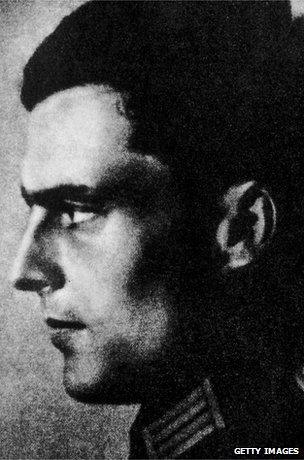
“I was a boy of 10, very interested in what was going on in the
world. I was just about to become a little Nazi, like all of us.
But we never discussed that with my father or my mother. If he had
discussed politics with us he couldn’t have shown his real feelings
because it would have been too dangerous. Children give things
away.”
As he recovered from his injuries, Stauffenberg was approached
by a group of conspirators led by Gen Henning von Tresckow, who
wanted to kill Hitler and overthrow the Nazi regime. Stauffenberg
became a leading member of the plot.
In the months that followed there were several abortive attempts
to kill Hitler and there was a growing fear that the Gestapo was
closing in on the conspirators.
But in 1944, Stauffenberg became chief of staff for the
commander of the German Replacement Army. The post gave him access
to Hitler and an opportunity to carry out the assassination.
The conspirators’ plan was fraught with risk. Stauffenberg would
carry explosives in his briefcase, through the security checks
surrounding the Wolf’s Lair, prime the bomb and place his briefcase
near Hitler during the daily briefing. He would then make his
excuses and leave the room. After the explosion, Stauffenberg would
dash back to Berlin where the conspirators would use the
Replacement Army to take control.
Berthold von Stauffenberg spoke to Witness on the BBC World
Service
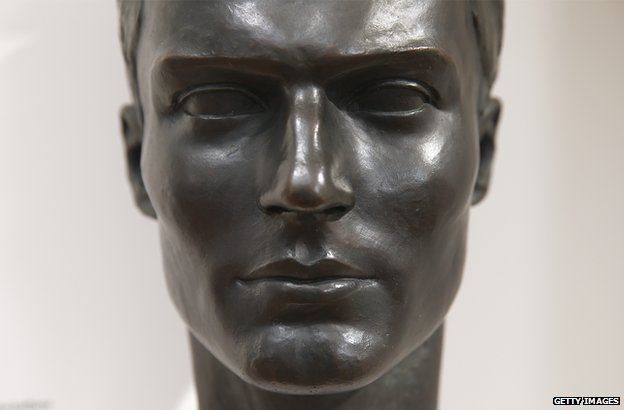
A bust of Claus von
Stauffenberg at the German Resistance Memorial
Center
“They were not sure they would succeed but Tresckow said the
attack on Hitler must go on, if only to prove that not all Germans
were his followers,” says Berthold.
But if the plot failed, it was not just the conspirators who
would be at risk. “My mother always said she knew what was planned.
She’d found out and confronted my father and so he told her. But
she didn’t know that he was to plant the bomb.”
(adsbygoogle = window.adsbygoogle || []).push({});
“They knew the consequences, but in times of war, life
is not as important as it is now in a peacetime environment. People
die all the time and to sacrifice oneself seems to be an enormous
thing, but in wartime it’s different.”
On Thursday 20 July, Stauffenberg arrived at the Wolf’s Lair –
the briefing was set for 12:30. But he was interrupted as he tried
to set the bomb, so he put only one of two explosive devices in his
briefcase before he entered the meeting.
“I remember that Stauffenberg had a big black briefcase under
his good arm,” said Warlimont in 1967.
“But then I didn’t look at him anymore, so I didn’t see him
putting it under the table, or leaving the room shortly afterwards.
About five to 10 minutes passed – I had forgotten about him when
the explosion happened.”
Stauffenberg saw the explosion as he left the compound to head
back to Berlin. He was sure that Hitler was dead.
But just before the explosion, Stauffenberg’s briefcase had been
moved behind a table leg away from Hitler. The bomb was not as
powerful as intended and Hitler was leaning over the thick oak
table looking at maps when it went off which shielded him from the
blast. Four died in the explosion and many were injured, but Hitler
survived.
“When the bomb went off I just had this feeling that a big
chandelier had fallen on my head. I went down. I saw Hitler was led
out of the room, supported on the arm of Keitel and my first
impression was that he was not injured at all, or at least not
seriously,” recalled Warlimont.
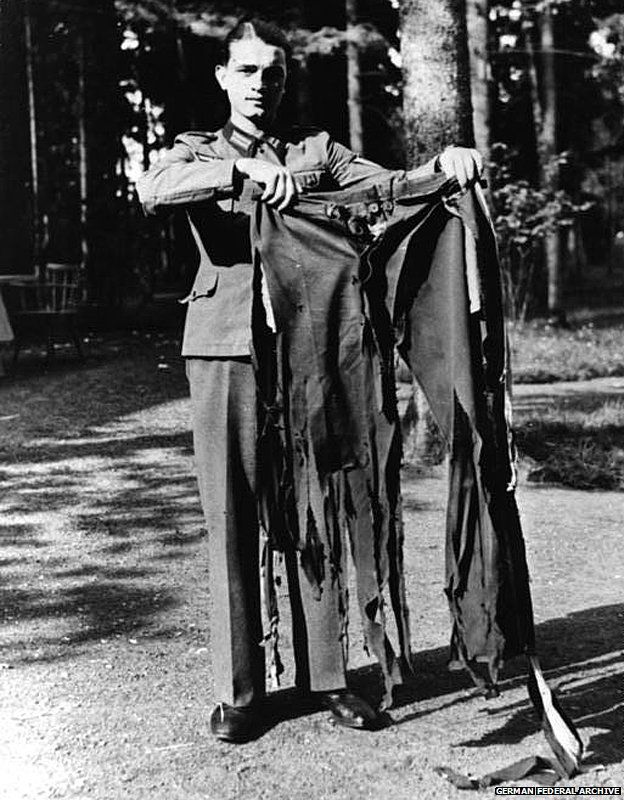
Image copyright German Federal Archive Image caption
The trousers Hitler was wearing when the bomb exploded
When, hours later, it became clear the Fuhrer was still alive,
the attempted takeover of Berlin fell apart. Stauffenberg and other
leading conspirators were arrested at the War Office in Berlin and
shot.
It was a total shock, I couldn’t believe it… we were brought up
in school to believe that the Fuhrer was a wonderful man
At the time, Stauffenberg’s pregnant wife, Nina, and their four
children were staying at the family’s estate in the Swabian hills.
Berthold didn’t know what was going on.
“I heard reports on the radio, reports that an attempt on
Hitler’s life had taken place and something about a small clique of
criminal and stupid officers. I was 10 years old and I read a
newspaper every day, I wanted to know what was going on. The
grown-ups tried to keep me away from the radio. Me and my brother
were sent on a long walk with my great uncle, Count Uxkull, who
told us a lot of things about his life hunting big deer in
Africa.”
“It was actually the next day that my mother took me and my
brother aside and told me that it was our father who’d laid the
bomb. I said ‘How, could he do it?’ And she said, ‘He believed he
had to do this for Germany.’”
“It was a total shock, I couldn’t believe it. An attack
on the Fuhrer! We were brought up in school and everywhere else, to
believe that the Fuhrer was a wonderful man.”
That night the Gestapo came – Berthold’s mother, grandmother and
great uncle were among those arrested. Berthold and his siblings
were sent to a children’s home.
“The reason why, was never discussed. We were given different
names – there is a theory that these were the names of families
where we would have been taken after the war, probably SS
families.”
In the aftermath, thousands were arrested and executed for their
alleged connection to the resistance. Berthold’s mother was taken
to a Gestapo prison at the Ravensbruck concentration camp. She was
reunited with her children after the war – she never remarried.
“For my mother there was my father and that was just it. He was the
man of her life.”
Berthold went on to become a general in the West German
army. He still lives in the family’s home town.
“For me there is no question that the plot has saved a little of
the honour of Germany.”
Berthold von Stauffenberg spoke to Witness on the BBC
World Service
Read more https://swordpress.com.ng/2020/10/09/the-german-officer-who-tried-to-kill-hitler/