
Trump Campaign Site Hacked – What We Know & Lessons
Learned
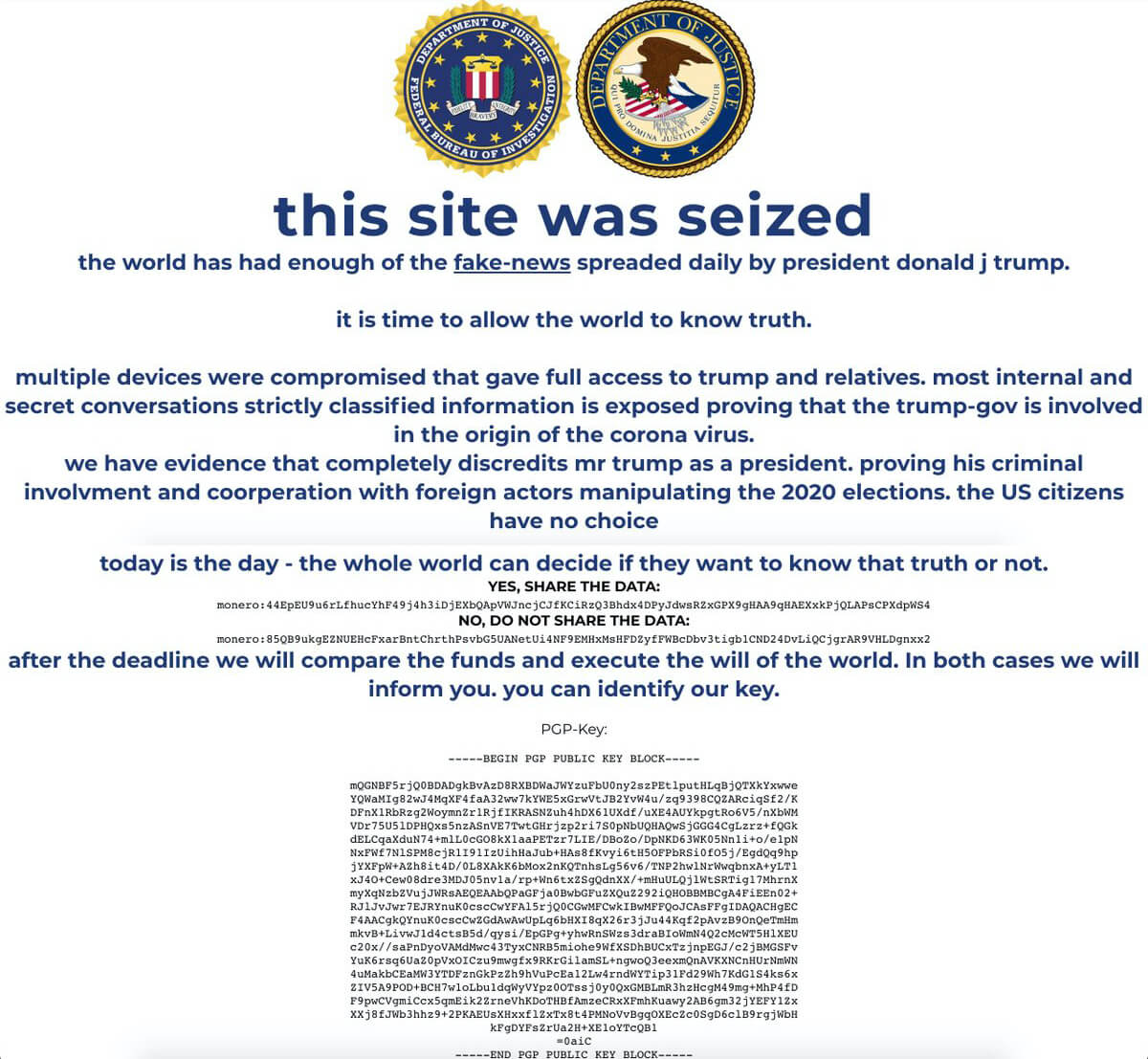
On October 27, 2020 at approximately 4:50pm Mountain Time,
Donald Trump’s campaign website, www.donaldjtrump.com, was defaced.
The attackers left a message claiming they had compromising
information on President Trump. The defacement page contained two
Monero cryptocurrency wallet IDs encouraging visitors to “vote” by
sending cryptocurrency to the wallets, indicating that if the first
wallet received more money than the second wallet, the attackers
would release this compromising information.
While the site was compromised, visitors were greeted with the
following:
Wordfence protects WordPress websites, and we offer a
hacked site cleaning service for WordPress site owners. Donald
Trump’s campaign website is hosted using Expression Engine, which
is an alternative content management system to WordPress. While
Wordfence doesn’t protect sites using Expression Engine, we thought
we’d take a look at the facts surrounding this incident and what
lessons we might learn.
Technical Analysis
The campaign website made use of the Expression Engine CMS, a
commercial CMS with few known vulnerabilities. The site used
Cloudflare as a content delivery network (CDN).
Since the site was protected by Cloudflare, the attackers would
not have been able to access the site via FTP or SSH unless they
knew the Origin IP, that is, the IP of the server hosting the site.
When a site uses Cloudflare, the Cloudflare servers are what site
visitors access, rather than the ‘origin’ server that actually
contains the content and any web application. Cloudflare tries to
hide the origin server IP address, making it difficult to access
that server unless you can discover the IP address.
The defacement page itself displayed two XMR (Monero) wallets.
Monero is a cryptocurrency popular amongst threat actors because it
uses an obfuscated public ledger. This means that, while
transactions are recorded, they’re not currently traceable. This
makes it impossible for outsiders to discover who sent money to
each wallet or the amounts involved.
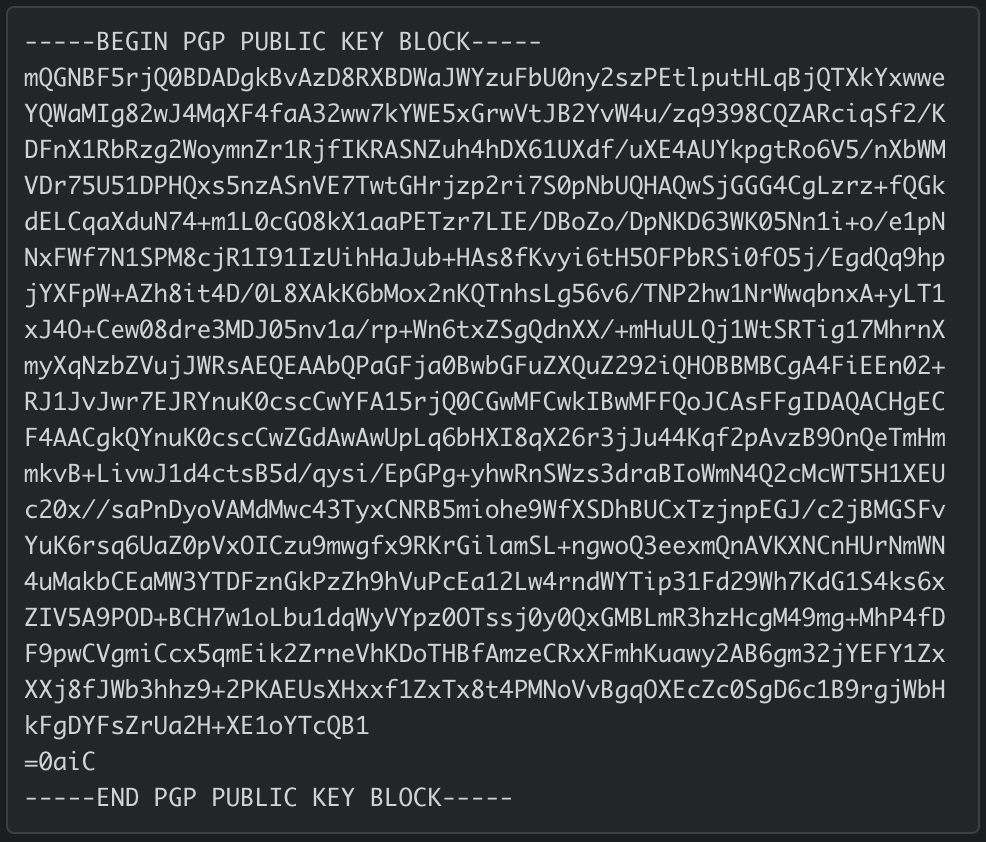
The attackers also left a Pretty Good Privacy(PGP) Public Key on
the defacement page. A PGP Public Key can be used to verify signed
messages and ensure that a message sender is the same person who
posted the public key. If the attackers later decided to release
information, they could prove they were the same threat actors who
defaced the site by signing released information with their private
key.
Only information signed with their private key would be
verifiable using the published public key. In this case, the Public
Key appears to correspond to a nonexistent email
address, hack@planet.gov. Nonetheless, we
have provided the PGP key for posterity:
Potential Intrusion Vectors(IVs)
There are several possible intrusion vectors, or mechanisms that
the attackers could have used to gain access and deface the Trump
campaign website. We describe several possibilities below, but to
be clear, without forensic evidence to verify these theories, we
cannot definitively know how the site was compromised.
In each case, compromised credentials are by far the most
probable Intrusion Vector. A Dutch Researcher recently claimed to
have accessed Trump’s Twitter account using the password
“maga2020!”. Trump’s Twitter account was also hacked In 2016 when a
data breach revealed that he was using the password
“yourefired”.
IV: Compromised credentials used to sign into Expression Engine
– High Probability
Expression Engine, like most content management systems,
provides an administrative panel for publishing content. By default
this is located at /admin.php. On donaldjtrump.com, however, the
admin login has been relocated to a different location, an example
of security through obscurity.
The Internet Archive indicates that the last time the admin page
was accessible in the default location was in June of 2015. Even in
this hidden location, if an attacker was able to access the
administrative panel they would have been able to alter any content
on the site, though they would not have had access to any sensitive
information.
(adsbygoogle = window.adsbygoogle || []).push({});
The “Privacy Policy” and “Terms & Conditions” pages are
displaying a “404 page not found” error hours after the site has
been restored. This indicates that something changed on the content
management system itself, rather than on the Cloudflare
configuration. So we believe that the CMS being compromised is
therefore a higher probability than Cloudflare being compromised,
which we describe below.
IV: Compromised credentials used to sign into Cloudflare –
Medium Probability
If an attacker was able to sign into the campaign’s Cloudflare
account, they could have pointed the domain to an IP address under
their control, effectively replacing the site’s content with the
content on their own hosting account. This might also explain how
the campaign was able to “restore” the original site content so
quickly.
Simply pointing the domain back to the correct IP would have
reverted the defacement. The fact that some pages on the site, such
as the “Privacy Policy” and the “Terms of Service” are still
displaying 404 errors at the time of our publication indicates that
this is a less likely intrusion vector.
IV: Compromised Credentials or Social Engineering used to
change domain nameservers at registrar – Low Probability
This would work using a similar mechanism to the Cloudflare
compromise. If an attacker was able to login to the account where
the domain donaldjtrump.com was registered, or socially engineer
their way into the account at the domain’s registrar, they might
have been able to point it away from Cloudflare’s nameservers and
to nameservers under their control.
The fact that some pages on the site are still displaying 404
errors indicates that this is a less likely possibility.
Additionally, nameserver changes typically take long enough to
propagate that the defaced page would likely still be visible from
some locations.
IV: Origin server hacked via FTP or SSH – Low Probability
This is the least likely scenario since the attackers would need
to know the site’s origin IP address as well as the FTP or SSH
credentials for the site’s hosting account in order to connect
directly to the site without being blocked by Cloudflare.
IV: Web Application Vulnerability – Low Probability
While it is possible that a vulnerability in Expression Engine
was exploited, Expression Engine has had few known vulnerabilities
and the chances of a 0-day vulnerability in this CMS remaining
unknown for long are low. Additionally, a vulnerability or exploit
chain would be required to allow privilege escalation or remote
code execution in order for the attacker to deface the site in this
manner.
Takeaway Lessons
Almost every possible scenario includes reused credentials being
exploited to gain access to the donaldjtrump.com site. In almost
every case, having 2-Factor Authentication enabled would have
prevented such a scenario from occurring. It’s also a reminder that
it is important to enable 2-Factor Authentication not only on your
website’s administrative panel, but on every service that offers
it, including services you might not think of as being
vulnerable.
If the credentials you are using have been exposed in a data
breach, it doesn’t matter how secure the service you’re using is.
By enabling 2-Factor Authentication, you add an extra layer of
protection.
While Wordfence doesn’t offer protection for
Expression Engine, we do offer best-in-class protection for
WordPress. This includes 2-Factor Authentication as a completely
free feature.
Don’t wait for an attacker to guess your password. Turn on
2-Factor Authentication to protect your web assets.