
What is conversion rate optimization software? More
commonly known as CRO, it generally aims to increase the chance of
web visitors turning into customers. Along the lead-to-conversion
process, CRO increases the probability of specific web visitors’
actions, such as: submitting a form, downloading an asset,
requesting for more information or subscribing to a free
trial.
The short definition of CRO is–it analyzes your web
visitors’ activities, the actions they take and did not take to
finish a process. Conversion is not limited to the actual customer
purchase, but a goal that is completed. This include mailing
opt-ins, asset downloads and free trial sign-ups.
The formula for conversion rate is: no. of unique goals
accomplished by the visitor (ex. purchase or opt-in) divided by the
number of unique times the same visitor dropped by your site.
Moz.com has a simple conversion rate example
here.[1]
CRO traces its roots on the post dotcom bubble, when
ecommerce sites started analyzing measurable metrics to gauge user
experience and how to improve it to increase sales. As the
ecommerce landscape became more competitive, so did marketers turn
to conversion rate optimization
software for actionable insights.[2]
In this guide, we will go beyond answering the definition
of conversion rate optimization software or–what is conversion rate
optimization software?–and walk you through its many aspects, such
as:
- Examples of conversion rate
optimization software[3] - Benefits of conversion rate
optimization software[4] - Types of conversion rate
optimization software[5] - Features of conversion rate
optimization software[6] - Buying factors to
consider[7] - Pricing of conversion rate
optimization software[8] - Potential issues[9]
- Latest trends[10]
The 70-20-10 Rule
Why use conversion rate optimization software? CRO helps
you optimize the marketing budget by having a clear picture of
where your traffic is coming from. Is it from paid advertising,
search or affiliate marketing? The insight should help you follow
the 70-20-10 rule, where you focus 70%
of your marketing on tried and tested marketing channels that have
been working for you so far; 20% on channels that have recently
gone mainstream and can no longer be ignored; and 10% on new
channels with potential. Your approach on the last should be agile,
so it’s responsive to new channels as they come and
go.[11]

Source: SmartInsights
Examples of Conversion Rate Optimization
Software
- Moz Pro.
It features SEO tools to help you improve your organic search
rankings, specifically your Domain Authority and Page Authority.
Likewise, it enables you to measure and track your competitors’
search rankings vis-a-vis your own. Among others, the app allows
you to follow the most profitable long-tail keywords for your site,
fix on-site SEO gaps and ensure your site is found and favored by
search engine crawlers.[12] - Optimizely. It is a
user experience-oriented app featuring quantitative tools such as
multivariate testing, multipage testing and behavioral audience
targeting. It also uses predictive analytics to personalize web
visitors’ experience. The app also features tools for mobile web
compatibility, campaign management and interface
customization.[13] - Unbounce.
It helps you build highly engaging landing pages including
mobile optimization. You have around 85 tried and tested templates
but also an option to design the page from scratch. Likewise, it
has features for campaign grouping, account transferring and IP
filtering.[14] - Yoast.
It is one of the widely used SEO tools for WordPress, which
helps you improve on-site SEO elements and eventually your search
rankings.[15] - Crazy
Egg. A heat map tool, this app identifies the
most engaging sections of your individual web pages. Using
color-coding overlay, it marks the most used sections on your page
in red, giving you visual clarity on where to focus
optimization.[16]

Moz Pro lets you see your search
visibility metrics and your competitors’.
Benefits of Conversion Rate Optimization
Software
What does conversion rate optimization software do?
Generally, it improves web visitor’s engagement so you end up
improving sales. Specifically, these are the advantages of
conversion rate optimization software.
- Understand your customer needs. By analyzing
traffic, general patterns emerge that help you identify who are
engaging or buying from you. Conversion rate optimization software
can analyze market segments by location, age, sex, profession and
other demographics; and where data is opted in, it can further hone
in on what tick your audience’s interest. This means your content
and deals can be developed to match customer interests and increase
the chances of conversion. - Discover new markets. As your business grows or
your product line expands, you may attract new market segments that
you might miss without a clear picture of your audience. CRO can
easily unearth this segment; for example, a spike in the sales
graph leads you to connect it with an event in another country that
proves to be profitable to your business. - Keep growing. CRO allows you to address each
customer interest or need; thus, prodding repeat buys or continuous
engagement. Moreover, it helps you turn more visits to sales,
ensuring your business keeps selling even as your old customer base
plateaus. - Build user trust. Knowing what interest your web
visitors helps you address their expectations or concerns on your
pages. They will see your pages as intuitive to their needs and,
possibly, linger longer, increasing the chances of conversion. CRO,
in fact, is a tool that helps you build user trust. - Optimize pages or processes. CRO allows you to
split test different versions of a page or process to leverage the
most number of leads or sales. Among others, you can A/B test
headlines, copy, CTAs, social proof elements and images and measure
the impact of each change. The result is, you increase
opportunities without having to invest more on web
traffic. - Better ROI. When you have a clear understanding of
your customer needs, a specific picture of your best-performing
online assets, such as, landing pages, white papers, content and
deals, goals are met and sales increases. CRO delivers better ROI
without having to increase your advertising budget.
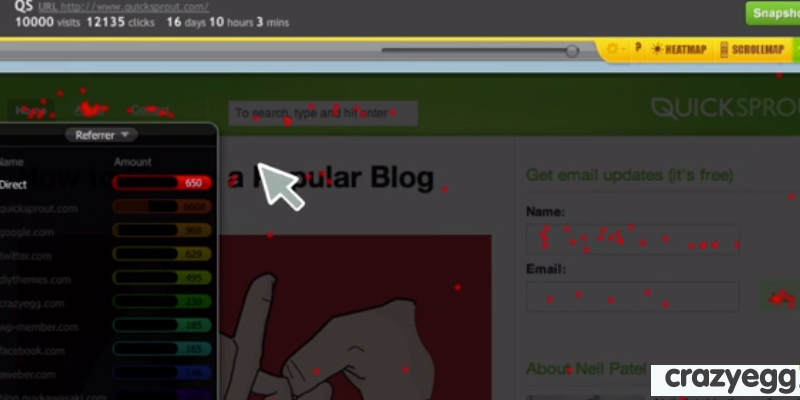
Crazy Egg marks the most used parts on
your page in red.
Types of Conversion Rate Optimization
Software
How does conversion rate optimization software work? The
answer depends on the CRO type. These CRO solutions may
overlap in functionalities, but they do have a core feature that
defines their type.
- Quantitative. This CRO type performs quantitative
analysis built around a core web analytics tool. It answers the
who, what, when and where of your website traffic. These include:
Where do visitors come? What are they doing on your pages? Who are
they (demographics)? When are they visiting most? By getting the
answers to these important questions, you can focus your effort on
critical metrics.
Example. Google
Analytics - Qualitative. This type focuses on qualitative
analysis or the why behind your web traffic. It features on-site
surveys, satisfaction surveys or user testing tools that help you
define large audience sets into smaller niches. This allows you to
focus on your most profitable market segments, each one with a
clear customer profile.
Example: UserTesting,
SurveyMonkey - Website optimizers. This type lumps together CRO
solutions that perform split testing, heat mapping and funnel
optimization as the main functionalities to improve your website.
These features help you to evaluate traffic sources and user
engagement on specific sections of your website.
Examples: KISSmetrics, CrazyEgg - Landing page optimizers. Many CRO solutions are
specific to optimizing landing pages to improve campaign results.
They have tools to help you refine the page title, social proofs,
CTAs, images, copy and the overall layout. These solutions are
must-haves to boost your campaign success rate.
Example: Unbounce
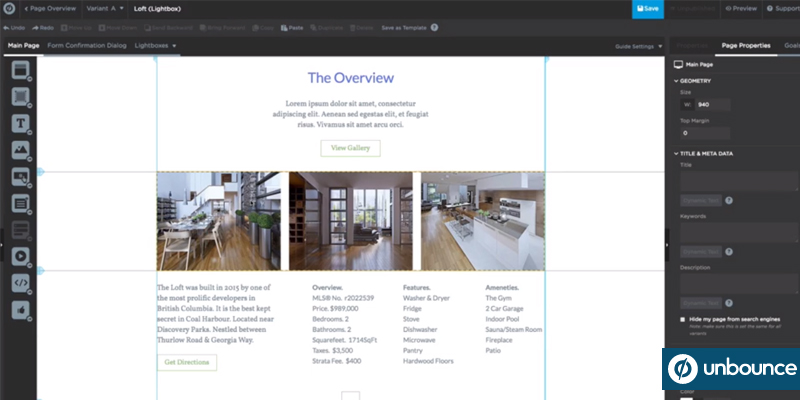
Unbounce helps you create pages with
optimized elements like typography, design and layout.
Features of Conversion Rate Optimization
Software
These are the features of conversion rate optimization
software. However, no single solution has all these tools. They are
usually packaged separately or bundled by CRO type.
- Analytics. This is the general set of features
that churn out measurable web traffic metrics such as clicks,
scrolls and form or shopping cart abandonment. You use these
metrics to build goals around and as benchmarks to measure your
success. - Heat map. Lets you visualize the most clicked
sections of your web pages. A heat map uses color coding overlay
(red being the hottest element) on a specific page. This is
commonly found in website optimizers. - Readability score. Evaluates if your content is
easy or difficult to read with a scoring meter that spans the gamut
of both extreme ends. - Typography tools. These are usually found on
landing page optimizers; they help you pull together the best
typographic elements such as font, size, width and characters per
line. - Survey tools. Quizzes, polls, multiple choices,
questionnaires and other survey forms are used to fish for web
visitor or customer feedback. These tools may also include
analytics and advanced logic for survey branching, block
randomization or custom variables. - A/B testing. It performs split or multivariate
tests on page designs, landing pages or ads for web and mobile to
help you fine tune a final version with the best chances of
conversion. - Landing page templates and tools. Ready templates
with tried and tested elements help you build landing pages and
launch campaigns on the fly. - Page rendering tools. Lets you test the
compatibility of your websites or landing pages with browsers and
mobile OS and devices. - Speed test. Specific CRO tools analyze your
website’s page loading speed and come up with recommendations for
improvement.
Buying factors to consider
Before you consider subscribing to a CRO solution, consider the
following factors to ensure you get the most ROI.
- Type of CRO you need. The features of conversion
rate optimization software above are often packaged separately or
bundled by type. That means you have to know first what type of CRO
you need so you match it with the right solution. Generally, you
need qualitative tools for a large audience set to identify its
parts. If you have well-defined visitor segments already, you need
quantitative tools to analyze each set’s behavior on your website.
If you are launching a campaign, you definitely want a solution
with landing page builder, A/B test tools or page rendering tools.
As no single CRO solution provides all these tools, you may end up
using 2-3 different CRO types. - Subscription flexibility. If you’re a small
business with limited funding, avoid long-term subscription terms.
Your CRO requirement will differ month to month (sometimes you will
need qualitative tools, sometimes quantitative, at other times you
may need a landing page builder) depending on your business
priority. Having a plan that allows you to change the tool month to
month makes you agile and optimizes your operational
budget. - Vendor reliability. Since you will be basing major
decisions on the data churned out by CRO, it is imperative the
solution is reliable. You do not want to make the right decision
based on wrong data. Check user reviews and ratings, and perform
DIY research on your shortlisted vendors. Major vendors like
Google, Moz.com and Unbounce almost always guarantee reliability,
but there may be more-fitting smaller vendors that you might miss
if you solely rely on branding. - Have a clear CRO process. Develop a CRO strategy
first before shopping around for tools. The plan helps you define
the goals and leverage CRO data to improve, not disrupt, your
website. The strategy consists of planning, monitoring and analysis
of CRO data. In the planning stage you need to define the
hypothesis, the length of testing period and the metrics to
measure. In the monitoring stage you need to keep tab of the
essential data and sift noise out of the picture. Lastly, you need
to understand statistical significance, if indeed the metrics do
impact on your business or don’t, and what steps are needed to
address the results. - Your CRO maturity. A business that is just
starting to implement CRO will have different requirements versus a
company that already has amassed traffic and testing datasets.
Novice users will probably start with free web analytics tools like
Google Analytics for basic web traffic feedback and standard A/B
tools to fine tune their landing pages. On the other hand, advanced
users may look for sophisticated profiling and targeting features
to zero in on their defined market niches.
Pricing of Conversion Rate Optimization
Software
How much is the cost of conversion rate optimization
software? The solutions vary in terms. To help you have an idea of
the marketplace, here are examples of conversion rate optimization
software and their pricing.
- Moz Pro. It features four monthly or yearly plans
starting at $99 per month. The plans are built around the number of
campaigns and scalable feature set. - Optimizely. It offers three plans that require a
request for quote. The plans are categorized by scalable feature
set, from the basic (A/B testing) to advanced tools (third-party
targeting). - Unbounce. It has four plans that match a growing
small business’ needs, starting from $49 per month. The plans are
organized by your business type, for example, for in-house
marketing team, client accounts and enterprise
requirements. - Yoast. Pricing starts at $199, but you need to
request for a quote for a customized plan. - Crazy Egg. It is available in four monthly plans
based on the number of monthly web visits. Subscription starts at
$9 per month.
Potential issues
The purpose of conversion rate optimization software is
not foolproof. In fact, it may be compromised if you fail to
address these issues.
- Lack of process. Optimizing conversion involves a
process to leverage insights. From data collection and processing
through hypothesis, defining goals and statistical learning, this
process ensures the CRO data is optimized for best outcome. Failure
to institute this process can result in failing to mine the gold
that CRO delivers. - Letting CRO decide for you. CRO is a tool that
helps you make important decisions. It will not deliver the
insights directly, but will churn out data that help you define an
insight. For example, does a sales increase reflect true business
growth or a cause of a market anomaly that temporarily benefited
your business? You still have to put the CRO data in the context of
other factors that impact on your business. - Undermining CRO. Despite CRO data staring you in
the face, your biases may undermine the insights you could have
derived from this tool. This is true when we are proven wrong or
our presumptions are challenged by data. For example, your audience
turns out to be not the ideal market you have in mind. When you
stick to your biases you are not only undermining CRO, but wasting
opportunities to grow the business. - Underutilizing CRO. When a CRO solution is
difficult to set up and use, you or your staff are less
likely to adopt it. Never mind that it has robust features and
advanced tools, if the tools are unused you are leaking money. It’s
better to choose an intuitive basic CRO package than a highly
technical sophisticated plan if you lack for a resident I.T. user.
Underutilizing CRO also happens when you fail to leverage all
features in your plan. - Using the wrong CRO approach. We have explained
above the different CRO types. It is tempting to jump in at once
and make decisions based on the analytics method (quantitative)
because the data is detailed and compelling. But sometimes,
qualitative data analysis like on-site surveys and user testing is
needed to discover the why behind the what, especially for a large
audience set, the further you can break it down to niches. On the
other hand, relying too much on surveys can lead to survey fatigue,
which messes up data. If you’re wondering when to use quantitative or qualitative
method, it is time to rediscover your professor’s
lecture.[17] - Replacing advertising with CRO. CRO enhances the
ROI on your advertising and campaigns and should not replace paid
promotions. In fact, you need to get your message out there first
via organic and paid channels before you have traffic to optimize
in your website.
Latest trends
Here are the three major shifts in the CRO industry that we
expect to see or further developed in the next few years.
- Personalized CRO. Many CRO solutions are utilizing
predictive analytics and other machine learning technologies to
customize content and even pages to fit a web visitor’s interest.
These solutions use individual visitors’ historical data and
activities on your website to predict what to display on their next
visit. - Live video feeds. These CRO technologies are now
being used and we can only expect more refined features in the next
few years. We will also see the expanded use of live social feeds,
gaining more prominence over evergreen content and digital assets.
Facebook is already testing a more expansive live video feeds and
video broadcasting to cash in on this trend. - The Dominance of giants. The web is increasingly
less democratized. Giant tech companies are walling off their
territories as small players are put under their influence. Google
is now the king of search; Facebook of social media; and Amazon of
ecommerce. The answer to, “What is conversion rate optimization
software?” as we know it, will become less of identifying your
traffic sources and more on how to optimize your presence in these
three major internet territories.
Category: B2B News, Featured
Articles[18][19]
Tags: Conversion Rate Optimization
Software[20]
References
- ^
conversion rate example here
(moz.com) - ^
conversion rate optimization
software
(conversion-rate-optimization.financesonline.com) - ^
Examples of
conversion rate optimization software
(financesonline.com) - ^
Benefits of
conversion rate optimization software
(financesonline.com) - ^
Types of conversion
rate optimization software
(financesonline.com) - ^
Features of
conversion rate optimization software
(financesonline.com) - ^
Buying factors to
consider (financesonline.com) - ^
Pricing of
conversion rate optimization software
(financesonline.com) - ^
Potential issues
(financesonline.com) - ^
Latest trends
(financesonline.com) - ^
70-20-10 rule
(www.smartinsights.com) - ^
Moz Pro
(reviews.financesonline.com) - ^
Optimizely
(reviews.financesonline.com) - ^
Unbounce
(reviews.financesonline.com) - ^
Yoast
(reviews.financesonline.com) - ^
Crazy Egg
(reviews.financesonline.com) - ^
when to use quantitative or
qualitative method (cirt.gcu.edu) - ^
B2B News
(financesonline.com) - ^
Featured Articles
(financesonline.com) - ^
Conversion Rate
Optimization Software (financesonline.com)
What is conversion rate optimization software? More
commonly known as CRO, it generally aims to increase the chance of
web visitors turning into customers. Along the lead-to-conversion
process, CRO increases the probability of specific web visitors’
actions, such as: submitting a form, downloading an asset,
requesting for more information or subscribing to a free
trial.
The short definition of CRO is–it analyzes your web
visitors’ activities, the actions they take and did not take to
finish a process. Conversion is not limited to the actual customer
purchase, but a goal that is completed. This include mailing
opt-ins, asset downloads and free trial sign-ups.
The formula for conversion rate is: no. of unique goals
accomplished by the visitor (ex. purchase or opt-in) divided by the
number of unique times the same visitor dropped by your site.
Moz.com has a simple conversion rate example
here.[1]
CRO traces its roots on the post dotcom bubble, when
ecommerce sites started analyzing measurable metrics to gauge user
experience and how to improve it to increase sales. As the
ecommerce landscape became more competitive, so did marketers turn
to conversion rate optimization
software for actionable insights.[2]
In this guide, we will go beyond answering the definition
of conversion rate optimization software or–what is conversion rate
optimization software?–and walk you through its many aspects, such
as:
- Examples of conversion rate
optimization software[3] - Benefits of conversion rate
optimization software[4] - Types of conversion rate
optimization software[5] - Features of conversion rate
optimization software[6] - Buying factors to
consider[7] - Pricing of conversion rate
optimization software[8] - Potential issues[9]
- Latest trends[10]
The 70-20-10 Rule
Why use conversion rate optimization software? CRO helps
you optimize the marketing budget by having a clear picture of
where your traffic is coming from. Is it from paid advertising,
search or affiliate marketing? The insight should help you follow
the 70-20-10 rule, where you focus 70% of your
marketing on tried and tested marketing channels that have been
working for you so far; 20% on channels that have recently gone
mainstream and can no longer be ignored; and 10% on new channels
with potential. Your approach on the last should be agile, so it’s
responsive to new channels as they come and go.[11]
Source: SmartInsights
Examples of Conversion
Rate Optimization Software
- Moz Pro.
It features SEO tools to help you improve your organic search
rankings, specifically your Domain Authority and Page Authority.
Likewise, it enables you to measure and track your competitors’
search rankings vis-a-vis your own. Among others, the app allows
you to follow the most profitable long-tail keywords for your site,
fix on-site SEO gaps and ensure your site is found and favored by
search engine crawlers.[12] - Optimizely. It is a user
experience-oriented app featuring quantitative tools such as
multivariate testing, multipage testing and behavioral audience
targeting. It also uses predictive analytics to personalize web
visitors’ experience. The app also features tools for mobile web
compatibility, campaign management and interface
customization.[13] - Unbounce.
It helps you build highly engaging landing pages including
mobile optimization. You have around 85 tried and tested templates
but also an option to design the page from scratch. Likewise, it
has features for campaign grouping, account transferring and IP
filtering.[14] - Yoast.
It is one of the widely used SEO tools for WordPress, which
helps you improve on-site SEO elements and eventually your search
rankings.[15] - Crazy
Egg. A heat map tool, this app identifies the
most engaging sections of your individual web pages. Using
color-coding overlay, it marks the most used sections on your page
in red, giving you visual clarity on where to focus
optimization.[16]
Moz Pro lets you see your search
visibility metrics and your competitors’.
Benefits of Conversion
Rate Optimization Software
What does conversion rate optimization software do?
Generally, it improves web visitor’s engagement so you end up
improving sales. Specifically, these are the advantages of
conversion rate optimization software.
- Understand your customer needs. By analyzing
traffic, general patterns emerge that help you identify who are
engaging or buying from you. Conversion rate optimization software
can analyze market segments by location, age, sex, profession and
other demographics; and where data is opted in, it can further hone
in on what tick your audience’s interest. This means your content
and deals can be developed to match customer interests and increase
the chances of conversion. - Discover new markets. As your business grows or
your product line expands, you may attract new market segments that
you might miss without a clear picture of your audience. CRO can
easily unearth this segment; for example, a spike in the sales
graph leads you to connect it with an event in another country that
proves to be profitable to your business. - Keep growing. CRO allows you to address each
customer interest or need; thus, prodding repeat buys or continuous
engagement. Moreover, it helps you turn more visits to sales,
ensuring your business keeps selling even as your old customer base
plateaus. - Build user trust. Knowing what interest your web
visitors helps you address their expectations or concerns on your
pages. They will see your pages as intuitive to their needs and,
possibly, linger longer, increasing the chances of conversion. CRO,
in fact, is a tool that helps you build user trust. - Optimize pages or processes. CRO allows you to
split test different versions of a page or process to leverage the
most number of leads or sales. Among others, you can A/B test
headlines, copy, CTAs, social proof elements and images and measure
the impact of each change. The result is, you increase
opportunities without having to invest more on web
traffic. - Better ROI. When you have a clear understanding of
your customer needs, a specific picture of your best-performing
online assets, such as, landing pages, white papers, content and
deals, goals are met and sales increases. CRO delivers better ROI
without having to increase your advertising budget.
Crazy Egg marks the most used parts on
your page in red.
Types of Conversion Rate
Optimization Software
How does conversion rate optimization software work? The
answer depends on the CRO type. These CRO solutions may
overlap in functionalities, but they do have a core feature that
defines their type.
- Quantitative. This CRO type performs quantitative
analysis built around a core web analytics tool. It answers the
who, what, when and where of your website traffic. These include:
Where do visitors come? What are they doing on your pages? Who are
they (demographics)? When are they visiting most? By getting the
answers to these important questions, you can focus your effort on
critical metrics.
Example. Google
Analytics - Qualitative. This type focuses on qualitative
analysis or the why behind your web traffic. It features on-site
surveys, satisfaction surveys or user testing tools that help you
define large audience sets into smaller niches. This allows you to
focus on your most profitable market segments, each one with a
clear customer profile.
Example: UserTesting,
SurveyMonkey - Website optimizers. This type lumps together CRO
solutions that perform split testing, heat mapping and funnel
optimization as the main functionalities to improve your website.
These features help you to evaluate traffic sources and user
engagement on specific sections of your website.
Examples: KISSmetrics, CrazyEgg - Landing page optimizers. Many CRO solutions are
specific to optimizing landing pages to improve campaign results.
They have tools to help you refine the page title, social proofs,
CTAs, images, copy and the overall layout. These solutions are
must-haves to boost your campaign success rate.
Example: Unbounce
Unbounce helps you create pages with
optimized elements like typography, design and layout.
Features of Conversion
Rate Optimization Software
These are the features of conversion rate optimization
software. However, no single solution has all these tools. They are
usually packaged separately or bundled by CRO type.
- Analytics. This is the general set of features
that churn out measurable web traffic metrics such as clicks,
scrolls and form or shopping cart abandonment. You use these
metrics to build goals around and as benchmarks to measure your
success. - Heat map. Lets you visualize the most clicked
sections of your web pages. A heat map uses color coding overlay
(red being the hottest element) on a specific page. This is
commonly found in website optimizers. - Readability score. Evaluates if your content is
easy or difficult to read with a scoring meter that spans the gamut
of both extreme ends. - Typography tools. These are usually found on
landing page optimizers; they help you pull together the best
typographic elements such as font, size, width and characters per
line. - Survey tools. Quizzes, polls, multiple choices,
questionnaires and other survey forms are used to fish for web
visitor or customer feedback. These tools may also include
analytics and advanced logic for survey branching, block
randomization or custom variables. - A/B testing. It performs split or multivariate
tests on page designs, landing pages or ads for web and mobile to
help you fine tune a final version with the best chances of
conversion. - Landing page templates and tools. Ready templates
with tried and tested elements help you build landing pages and
launch campaigns on the fly. - Page rendering tools. Lets you test the
compatibility of your websites or landing pages with browsers and
mobile OS and devices. - Speed test. Specific CRO tools analyze your
website’s page loading speed and come up with recommendations for
improvement.
Buying factors to
consider
Before you consider subscribing to a CRO solution, consider the
following factors to ensure you get the most ROI.
- Type of CRO you need. The features of conversion
rate optimization software above are often packaged separately or
bundled by type. That means you have to know first what type of CRO
you need so you match it with the right solution. Generally, you
need qualitative tools for a large audience set to identify its
parts. If you have well-defined visitor segments already, you need
quantitative tools to analyze each set’s behavior on your website.
If you are launching a campaign, you definitely want a solution
with landing page builder, A/B test tools or page rendering tools.
As no single CRO solution provides all these tools, you may end up
using 2-3 different CRO types. - Subscription flexibility. If you’re a small
business with limited funding, avoid long-term subscription terms.
Your CRO requirement will differ month to month (sometimes you will
need qualitative tools, sometimes quantitative, at other times you
may need a landing page builder) depending on your business
priority. Having a plan that allows you to change the tool month to
month makes you agile and optimizes your operational
budget. - Vendor reliability. Since you will be basing major
decisions on the data churned out by CRO, it is imperative the
solution is reliable. You do not want to make the right decision
based on wrong data. Check user reviews and ratings, and perform
DIY research on your shortlisted vendors. Major vendors like
Google, Moz.com and Unbounce almost always guarantee reliability,
but there may be more-fitting smaller vendors that you might miss
if you solely rely on branding. - Have a clear CRO process. Develop a CRO strategy
first before shopping around for tools. The plan helps you define
the goals and leverage CRO data to improve, not disrupt, your
website. The strategy consists of planning, monitoring and analysis
of CRO data. In the planning stage you need to define the
hypothesis, the length of testing period and the metrics to
measure. In the monitoring stage you need to keep tab of the
essential data and sift noise out of the picture. Lastly, you need
to understand statistical significance, if indeed the metrics do
impact on your business or don’t, and what steps are needed to
address the results. - Your CRO maturity. A business that is just
starting to implement CRO will have different requirements versus a
company that already has amassed traffic and testing datasets.
Novice users will probably start with free web analytics tools like
Google Analytics for basic web traffic feedback and standard A/B
tools to fine tune their landing pages. On the other hand, advanced
users may look for sophisticated profiling and targeting features
to zero in on their defined market niches.
Pricing of Conversion Rate
Optimization Software
How much is the cost of conversion rate optimization
software? The solutions vary in terms. To help you have an idea of
the marketplace, here are examples of conversion rate optimization
software and their pricing.
- Moz Pro. It features four monthly or yearly plans
starting at $99 per month. The plans are built around the number of
campaigns and scalable feature set. - Optimizely. It offers three plans that require a
request for quote. The plans are categorized by scalable feature
set, from the basic (A/B testing) to advanced tools (third-party
targeting). - Unbounce. It has four plans that match a growing
small business’ needs, starting from $49 per month. The plans are
organized by your business type, for example, for in-house
marketing team, client accounts and enterprise
requirements. - Yoast. Pricing starts at $199, but you need to
request for a quote for a customized plan. - Crazy Egg. It is available in four monthly plans
based on the number of monthly web visits. Subscription starts at
$9 per month.
Potential issues
The purpose of conversion rate optimization software is
not foolproof. In fact, it may be compromised if you fail to
address these issues.
- Lack of process. Optimizing conversion involves a
process to leverage insights. From data collection and processing
through hypothesis, defining goals and statistical learning, this
process ensures the CRO data is optimized for best outcome. Failure
to institute this process can result in failing to mine the gold
that CRO delivers. - Letting CRO decide for you. CRO is a tool that
helps you make important decisions. It will not deliver the
insights directly, but will churn out data that help you define an
insight. For example, does a sales increase reflect true business
growth or a cause of a market anomaly that temporarily benefited
your business? You still have to put the CRO data in the context of
other factors that impact on your business. - Undermining CRO. Despite CRO data staring you in
the face, your biases may undermine the insights you could have
derived from this tool. This is true when we are proven wrong or
our presumptions are challenged by data. For example, your audience
turns out to be not the ideal market you have in mind. When you
stick to your biases you are not only undermining CRO, but wasting
opportunities to grow the business. - Underutilizing CRO. When a CRO solution is
difficult to set up and use, you or your staff are less
likely to adopt it. Never mind that it has robust features and
advanced tools, if the tools are unused you are leaking money. It’s
better to choose an intuitive basic CRO package than a highly
technical sophisticated plan if you lack for a resident I.T. user.
Underutilizing CRO also happens when you fail to leverage all
features in your plan. - Using the wrong CRO approach. We have explained
above the different CRO types. It is tempting to jump in at once
and make decisions based on the analytics method (quantitative)
because the data is detailed and compelling. But sometimes,
qualitative data analysis like on-site surveys and user testing is
needed to discover the why behind the what, especially for a large
audience set, the further you can break it down to niches. On the
other hand, relying too much on surveys can lead to survey fatigue,
which messes up data. If you’re wondering when to use quantitative or qualitative
method, it is time to rediscover your professor’s
lecture.[17] - Replacing advertising with CRO. CRO enhances the
ROI on your advertising and campaigns and should not replace paid
promotions. In fact, you need to get your message out there first
via organic and paid channels before you have traffic to optimize
in your website.
Latest trends
Here are the three major shifts in the CRO industry that we
expect to see or further developed in the next few years.
- Personalized CRO. Many CRO solutions are utilizing
predictive analytics and other machine learning technologies to
customize content and even pages to fit a web visitor’s interest.
These solutions use individual visitors’ historical data and
activities on your website to predict what to display on their next
visit. - Live video feeds. These CRO technologies are now
being used and we can only expect more refined features in the next
few years. We will also see the expanded use of live social feeds,
gaining more prominence over evergreen content and digital assets.
Facebook is already testing a more expansive live video feeds and
video broadcasting to cash in on this trend. - The Dominance of giants. The web is increasingly
less democratized. Giant tech companies are walling off their
territories as small players are put under their influence. Google
is now the king of search; Facebook of social media; and Amazon of
ecommerce. The answer to, “What is conversion rate optimization
software?” as we know it, will become less of identifying your
traffic sources and more on how to optimize your presence in these
three major internet territories.
Category: B2B News, Featured
Articles[18][19]
Tags: Conversion Rate Optimization Software[20]
References
- ^
conversion rate example here
(moz.com) - ^
conversion rate optimization software
(conversion-rate-optimization.financesonline.com) - ^
Examples of
conversion rate optimization software
(financesonline.com) - ^
Benefits of
conversion rate optimization software
(financesonline.com) - ^
Types of conversion
rate optimization software
(financesonline.com) - ^
Features of
conversion rate optimization software
(financesonline.com) - ^
Buying factors to
consider (financesonline.com) - ^
Pricing of
conversion rate optimization software
(financesonline.com) - ^
Potential issues
(financesonline.com) - ^
Latest trends
(financesonline.com) - ^
70-20-10 rule
(www.smartinsights.com) - ^
Moz Pro
(reviews.financesonline.com) - ^
Optimizely
(reviews.financesonline.com) - ^
Unbounce
(reviews.financesonline.com) - ^
Yoast
(reviews.financesonline.com) - ^
Crazy Egg
(reviews.financesonline.com) - ^
when to use quantitative or qualitative method
(cirt.gcu.edu) - ^
B2B News
(financesonline.com) - ^
Featured Articles
(financesonline.com) - ^
Conversion Rate
Optimization Software (financesonline.com)
Read more https://financesonline.com/conversion-rate-optimization-software-analysis-features-benefits-pricing/