
 Project management offices (PMOs) today
have a range of tools to help them not only to complete projects,
but ensure these are aligned with organizational goals. PMOs today
also do more than implementing projects; they are now accountable
to budgeting, resource allocation and strategic alignment. These
responsibilities in mind, PMOs rely on cloud project management
solutions that give them the following: visibility, scalability,
visualization, collaboration, accessibility, integration and
mobility.
In fact, if we look at the top cloud project management
software[1] today, they encompass
these features. They can present the project’s progress in
dashboards or drill down to specifics with a few clicks. They can
immediately scale features for complex projects. They can generate
visual charts and graphs. They have communication and collaboration
tools that can integrate with other business apps and accessed from
smartphones.
It wasn’t a single stroke of event, however, that delivered
these powerful tools to PMOs. In this article, we’ll look at how
these features came to be, the history & development of PMO
tools and trends for the future.
Origins: How PMO Came To Being
PMOs as a business unit had their origin in the use of
scientific management method introduced by Frederick Taylor. In
1909, he published “The Principles of Scientific
Management.” He was the first to scientifically connect
efficiency to optimization, that working hard isn’t the key to get
things done, but working right is.
Fast forward to the thirties, the U.S. Air Corps designated a
project office to track its aircraft development. Many believe this
is the first recorded expression of a PMO. The U.S. would build on
this, and by the fifties, the Navy would adopt and popularize the
work breakdown structure (WBS) as a project management approach,
when it was building the Polaris missile defense.
Throughout the sixties, PMO was largely the function of complex
projects, such as, aerospace, weapons development and construction.
PMO wasn’t yet a business unit around this time. The concept
would take shape in 1969, when the Project Management Institute
(PMI) was founded. Its objectives were a mouthful, but it’s clearly
defining a PMO:
“… foster recognition of the need for professionalism in
project management; provide a forum for the free exchange of
project management problems, solutions and applications; coordinate
industrial and academic research efforts; develop common
terminology and techniques to improve communications; provide
interface between users and suppliers of hardware and software
systems; and to provide guidelines for instruction and career
development in the field of project management.”
Digital revolution: Visibility
By the early eighties, PMO trends in business applied primarily
to enterprise But with the popularity of PC and the global economic
boom spurred by I.T., smaller companies started to search for more
efficient ways to to manage projects.
As these companies took in more projects, they were unprepared.
Delays, cost overruns and overall project quality were prevalent.
There’s a need to standardize approaches and methodologies and
better coordination among project stakeholders.
Events would lead to the popularity of professional associations
and certifications. The eighties would give us Theory of
Constraints, Scrum as a project management methodology, PMBOK and
PRINCE. At the core of these schools of thought is project
visibility, the ability to map out paths and monitor progress at
different project stages.
The concept of PMO as we know it today really took shape around
this time, with no small effort from industry players like PMI and
IPMA agreeing what it is, how it fits an organization and what it
is supposed to do.
Around this time, too, the stereotyped project manager also took
shape, one who would forever etched in staff’s mind: someone who
can’t do so he or she teaches; who plays by the book; and armed
with certifications from an alphabet soup of acronyms.
These stereotypes were borne out of standardization; in truth,
these labels mirror the role of project managers: his or her job is
to manage not do tasks; he or she sticks to proven methodologies;
and his or her skills are validated and vouched by experts.
Decades hence, the image of project managers, the delegator as
opposed to doers, would be further validated by success stories in
Silicon Valley. We would know more of Bill Gates not Paul Allen,
Steve Jobs, not Steve Wozniak and Mark Zuckerberg, not Dustin
Moskovitz.
Back then, the digital revolution in the eighties though would
be expensive for small and mid-sized companies. The systems were
enterprise, cumbersome, proprietary and managed by an IT
department. PMOs needed a winning software product that would
democratize project management tools. And Microsoft had just the
tool.
The Rise of Microsoft Project:
Scalability
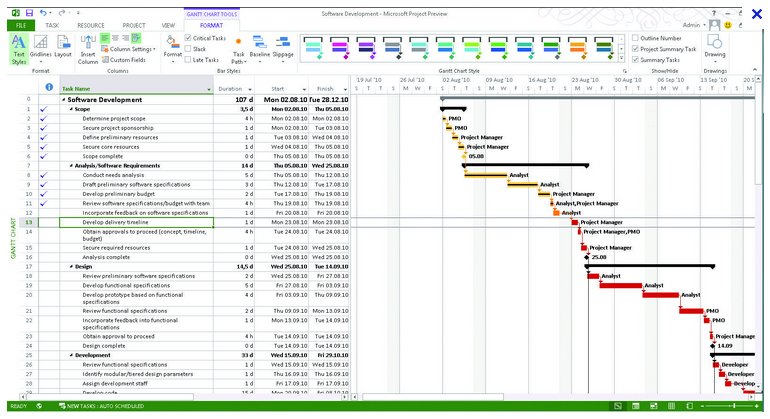
The nineties saw the rise of Microsoft Project as the holy grail
of PMO tools. The decade before it had PMOs dreaming of getting
their hands on enterprise solutions that, by far, were the province
of huge companies. And now they had Project off the shelf.
Project would shape the functionalities of future plug-and-play
project management solutions. It had at its core, modules that
solutions today are built around. Project would assist managers to
develop a plan, assign resources, track progress, manage the budget
and analyze workloads right from their PC. Interestingly, PMOs have
eggs Benedict to thank for.
The seed that would grow into Microsoft Project is traced to a
former IBM employee, Ron Bredehoeft, who imagined in mid-eighties
how project managers would prepare eggs Benedict. The idea led
Bredehoeft to work with Microsoft, which bought all rights for its
1984 DOS version.
But Project would take a decade more to get traction. The
solution had the performance, but it’s lacking one essential
feature that we enjoy now: visualization.
Project would only really take off when it released a Windows 95
version. By then, PCs were already a ubiquitous office equipment
and graphical interface was the norm. Word and Excel were the
standard by which user experience was benchmarked. Small and
mid-level PMOs with a PC, a huge untapped market as of yet,
were eager for their killer app.
In reality, PMOs were already using and grown to like a killer
app even before getting their hands on Project: Excel. It is
designed to replace spreadsheets and suited PMOs. Project managers
could visualize graphs and charts. Users were experts in macros to
cut repetitive tasks.
Already, we were seeing two universal features, visualization
and automation, in project management solutions at this time. At
this time, too, Microsoft had two of the most used PMO tools
and had another tool in coming that would make up the trinity of
project management tools of this era.
Enter the big picture
Automation back then was more of a suggestion. PMOs had to work
around the available tools in those early days, mainly Excel and
Project, to automate workflows. Project plans were created in
Project, stored a server and exported to Excel and macros had to be
created.
The concept of a single location for all project data was a
dream. PMOs would still be using Excel for macros and Project to
create Gantt charts.
Executives found the whole mashed-up data confusing and too
cumbersome to get the whole picture. So PMOs started creating
PowerPoint slides, adding yet another layer to their already loaded
system stack.
To top it all, you can’t teach old dogs new tricks, even less of
a chance, wean project managers from their favorite tools. So you
would see a project team of young professionals using Excel,
Project and PowerPoint, while their middle-aged managers would
stick to boards with magnetic pins or Post-It notes in candy
colors. It’s easy to view these as relics of the pre-digital
revolution age but, truth be told, they would spur yet another
revolution in PMO history.
Visualization, not just visibility, comes to
project management
The use of visual ticklers had been around since ages ago,
beyond one’s grandfather’s time, yes, like ancient Egypt.
Hieroglyphics were discovered depicting an organogram. It showed
how different teams were allocated and roles were defined. In fact,
it is believed each side of the pyramid had its own project
manager. The ancient
Egyptians were clearly practicing WBS[2].
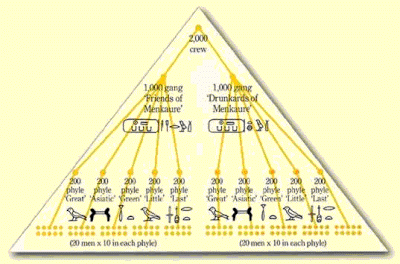
Is this the first organizational chart?
(source: NQICorp.com)
The candy-colored boards didn’t go away in the face of Excel,
Project and PowerPoint because they’re adaptive. If John fell sick
for a week, for example, you could easily move his priority tasks
under Peter, and shelf off Peter’s non-priority tasks. Delays are
avoided.
Microsoft Project was still lording it over PMO tools, but by
early 2000s, there’s a clear need to incorporate visual boards, not
just Gantt charts, for the big picture. The boards would become a
major key feature in top project management solutions of today.
Collaboration and customers take
centerstage
Around 2001, a group of software developers met in Snowbird, UT
to think up how agile methodology applies to software development.
They wrote the Manifesto for Agile Software Development.
While agile management is not new, it has been implemented
in manufacturing and inventory since the forties, its role in
software development was just starting. The manifesto wasn’t
adopted wide and far at once, but it laid the foundation of another
key element in today’s solutions: user experience above all.
Overall, the manifesto made
project managers aware of four priorities[3]:
- Individuals and interactions over processes and tools.
- Functional software over robust documentation.
- Customer collaboration over contract terms.
- Responding to change over sticking to plan.
Today, you hear from vendors of intuitive interface, dashboards,
collaboration tools and scalable plans. The manifesto didn’t
develop these concepts; what it did though was to pull these
priorities together and apply them to software development. And it
worked, that, in fact, the manifesto would define what a great
software solution is today, not just in project management, but in
other software categories, too, like sales, marketing and
support.
Cloud cometh: accessibility, integration,
mobile
The introduction of Salesforce in the early 1999 would send
ripples across business processes. Cloud computing had arrived to
small and mid-sized businesses. The idea of accessing a system via
website was exciting and would be adopted across business
processes. But it’d take a few more years before PMOs got their
real shot at the cloud. Sales and marketing solutions and cloud
business and productivity apps led by Salesforce, Amazon and Google
would popularize first cloud computing, before the technology
caught fire among PMOs.
For project management, SaaS solutions for teams would gain
traction around 2008. PMOs would enjoy a wide range of options from
hereon, as vendors vied for market share. But external factors were
also at work that made cloud computing more efficient than
on-premise. A year earlier, a device was launched by Apple that
would also enhance cloud computing: iPhone. In reality, it isn’t a
phone but a computer tucked in your pocket.
Furthermore, with plenty of business apps in the market by this
time, we would also be conscious of another key feature in project
management software: integration.
Spurred by the ubiquity of project management tools, its
ease-of-use and low capital entry points, companies started using
these tools as a collaboration platform across departments.
The Evolved PMO
Today’s solutions can handle almost anything that involves
planning, collaboration, scheduling and managing. A marketing
campaign can be managed by utilizing project management boards to
move tasks from To-do, to Doing and to Done. A business strategy
can be captured, organized into subtasks and tracked for milestones
inside a project management interface. HR can also turn to project
management software for talent management.
Along with CRM, project management is arguably one of the few
software niches that have absorbed other niches. A typical project
management solution today has modules for task management,
communication apps, collaboration tools, time-tracking widget and
project accounting, all of which belong to their respective
software categories.
What do all these suggest of PMO’s role? While PMOs are
cross-function groups, they are also being absorbed into other
departments. In fact, companies started to regard project
management skills as key to managerial positions, instead of a
standalone role. U.S. News, for example, classified project
management as one skill to earn a well-paying job[4]. Whether you’re a CEO,
CIO, CMO, marketer, operations supervisor, HR manager or events
organizer, you’ll be utilizing project management tools.
Today’s PMOs have a full-service outlook. They are strategically
aligned with the organization’s overall goal. They provide
support to project stakeholders, from the team member on the ground
to the investor in another country. They are agile and highly
collaborative, able to adjust to changes while keeping to the
deadline. And they are one of the most digitally competent units
outside of I.T. and ready for more PMO trends in the coming
years.
Category: B2B News, Featured Articles[5][6]
Tags: Project Management Software[7]
References
- ^
project management software
(project-management-software.financesonline.com) - ^
ancient Egyptians were clearly
practicing WBS (www.nqicorp.com) - ^
made project managers aware of four
priorities (www.agilealliance.org) - ^
project management as one skill to earn
a well-paying job (www.usnews.com) - ^
B2B News
(financesonline.com) - ^
Featured Articles
(financesonline.com) - ^
Project Management Software
(financesonline.com)
Project management offices (PMOs) today
have a range of tools to help them not only to complete projects,
but ensure these are aligned with organizational goals. PMOs today
also do more than implementing projects; they are now accountable
to budgeting, resource allocation and strategic alignment. These
responsibilities in mind, PMOs rely on cloud project management
solutions that give them the following: visibility, scalability,
visualization, collaboration, accessibility, integration and
mobility.
In fact, if we look at the top cloud project management
software[1] today, they encompass
these features. They can present the project’s progress in
dashboards or drill down to specifics with a few clicks. They can
immediately scale features for complex projects. They can generate
visual charts and graphs. They have communication and collaboration
tools that can integrate with other business apps and accessed from
smartphones.
It wasn’t a single stroke of event, however, that delivered
these powerful tools to PMOs. In this article, we’ll look at how
these features came to be, the history & development of PMO
tools and trends for the future.
Origins: How PMO Came To Being
PMOs as a business unit had their origin in the use of
scientific management method introduced by Frederick Taylor. In
1909, he published “The Principles of Scientific
Management.” He was the first to scientifically connect
efficiency to optimization, that working hard isn’t the key to get
things done, but working right is.
Fast forward to the thirties, the U.S. Air Corps designated a
project office to track its aircraft development. Many believe this
is the first recorded expression of a PMO. The U.S. would build on
this, and by the fifties, the Navy would adopt and popularize the
work breakdown structure (WBS) as a project management approach,
when it was building the Polaris missile defense.
Throughout the sixties, PMO was largely the function of complex
projects, such as, aerospace, weapons development and construction.
PMO wasn’t yet a business unit around this time. The concept
would take shape in 1969, when the Project Management Institute
(PMI) was founded. Its objectives were a mouthful, but it’s clearly
defining a PMO:
“… foster recognition of the need for professionalism in
project management; provide a forum for the free exchange of
project management problems, solutions and applications; coordinate
industrial and academic research efforts; develop common
terminology and techniques to improve communications; provide
interface between users and suppliers of hardware and software
systems; and to provide guidelines for instruction and career
development in the field of project management.”
Digital revolution: Visibility
By the early eighties, PMO trends in business applied primarily
to enterprise But with the popularity of PC and the global economic
boom spurred by I.T., smaller companies started to search for more
efficient ways to to manage projects.
As these companies took in more projects, they were unprepared.
Delays, cost overruns and overall project quality were prevalent.
There’s a need to standardize approaches and methodologies and
better coordination among project stakeholders.
Events would lead to the popularity of professional associations
and certifications. The eighties would give us Theory of
Constraints, Scrum as a project management methodology, PMBOK and
PRINCE. At the core of these schools of thought is project
visibility, the ability to map out paths and monitor progress at
different project stages.
The concept of PMO as we know it today really took shape around
this time, with no small effort from industry players like PMI and
IPMA agreeing what it is, how it fits an organization and what it
is supposed to do.
Around this time, too, the stereotyped project manager also took
shape, one who would forever etched in staff’s mind: someone who
can’t do so he or she teaches; who plays by the book; and armed
with certifications from an alphabet soup of acronyms.
These stereotypes were borne out of standardization; in truth,
these labels mirror the role of project managers: his or her job is
to manage not do tasks; he or she sticks to proven methodologies;
and his or her skills are validated and vouched by experts.
Decades hence, the image of project managers, the delegator as
opposed to doers, would be further validated by success stories in
Silicon Valley. We would know more of Bill Gates not Paul Allen,
Steve Jobs, not Steve Wozniak and Mark Zuckerberg, not Dustin
Moskovitz.
Back then, the digital revolution in the eighties though would
be expensive for small and mid-sized companies. The systems were
enterprise, cumbersome, proprietary and managed by an IT
department. PMOs needed a winning software product that would
democratize project management tools. And Microsoft had just the
tool.
The Rise of Microsoft Project:
Scalability
The nineties saw the rise of Microsoft Project as the holy grail
of PMO tools. The decade before it had PMOs dreaming of getting
their hands on enterprise solutions that, by far, were the province
of huge companies. And now they had Project off the shelf.
Project would shape the functionalities of future plug-and-play
project management solutions. It had at its core, modules that
solutions today are built around. Project would assist managers to
develop a plan, assign resources, track progress, manage the budget
and analyze workloads right from their PC. Interestingly, PMOs have
eggs Benedict to thank for.
The seed that would grow into Microsoft Project is traced to a
former IBM employee, Ron Bredehoeft, who imagined in mid-eighties
how project managers would prepare eggs Benedict. The idea led
Bredehoeft to work with Microsoft, which bought all rights for its
1984 DOS version.
But Project would take a decade more to get traction. The
solution had the performance, but it’s lacking one essential
feature that we enjoy now: visualization.
Project would only really take off when it released a Windows 95
version. By then, PCs were already a ubiquitous office equipment
and graphical interface was the norm. Word and Excel were the
standard by which user experience was benchmarked. Small and
mid-level PMOs with a PC, a huge untapped market as of yet,
were eager for their killer app.
In reality, PMOs were already using and grown to like a killer
app even before getting their hands on Project: Excel. It is
designed to replace spreadsheets and suited PMOs. Project managers
could visualize graphs and charts. Users were experts in macros to
cut repetitive tasks.
Already, we were seeing two universal features, visualization
and automation, in project management solutions at this time. At
this time, too, Microsoft had two of the most used PMO tools
and had another tool in coming that would make up the trinity of
project management tools of this era.
Enter the big picture
Automation back then was more of a suggestion. PMOs had to work
around the available tools in those early days, mainly Excel and
Project, to automate workflows. Project plans were created in
Project, stored a server and exported to Excel and macros had to be
created.
The concept of a single location for all project data was a
dream. PMOs would still be using Excel for macros and Project to
create Gantt charts.
Executives found the whole mashed-up data confusing and too
cumbersome to get the whole picture. So PMOs started creating
PowerPoint slides, adding yet another layer to their already loaded
system stack.
To top it all, you can’t teach old dogs new tricks, even less of
a chance, wean project managers from their favorite tools. So you
would see a project team of young professionals using Excel,
Project and PowerPoint, while their middle-aged managers would
stick to boards with magnetic pins or Post-It notes in candy
colors. It’s easy to view these as relics of the pre-digital
revolution age but, truth be told, they would spur yet another
revolution in PMO history.
Visualization, not just visibility, comes to
project management
The use of visual ticklers had been around since ages ago,
beyond one’s grandfather’s time, yes, like ancient Egypt.
Hieroglyphics were discovered depicting an organogram. It showed
how different teams were allocated and roles were defined. In fact,
it is believed each side of the pyramid had its own project
manager. The ancient
Egyptians were clearly practicing WBS[2].
Is this the first organizational chart?
(source: NQICorp.com)
The candy-colored boards didn’t go away in the face of Excel,
Project and PowerPoint because they’re adaptive. If John fell sick
for a week, for example, you could easily move his priority tasks
under Peter, and shelf off Peter’s non-priority tasks. Delays are
avoided.
Microsoft Project was still lording it over PMO tools, but by
early 2000s, there’s a clear need to incorporate visual boards, not
just Gantt charts, for the big picture. The boards would become a
major key feature in top project management solutions of today.
Collaboration and customers take
centerstage
Around 2001, a group of software developers met in Snowbird, UT
to think up how agile methodology applies to software development.
They wrote the Manifesto for Agile Software Development.
While agile management is not new, it has been implemented
in manufacturing and inventory since the forties, its role in
software development was just starting. The manifesto wasn’t
adopted wide and far at once, but it laid the foundation of another
key element in today’s solutions: user experience above all.
Overall, the manifesto made
project managers aware of four priorities[3]:
- Individuals and interactions over processes and tools.
- Functional software over robust documentation.
- Customer collaboration over contract terms.
- Responding to change over sticking to plan.
Today, you hear from vendors of intuitive interface, dashboards,
collaboration tools and scalable plans. The manifesto didn’t
develop these concepts; what it did though was to pull these
priorities together and apply them to software development. And it
worked, that, in fact, the manifesto would define what a great
software solution is today, not just in project management, but in
other software categories, too, like sales, marketing and
support.
Cloud cometh: accessibility, integration,
mobile
The introduction of Salesforce in the early 1999 would send
ripples across business processes. Cloud computing had arrived to
small and mid-sized businesses. The idea of accessing a system via
website was exciting and would be adopted across business
processes. But it’d take a few more years before PMOs got their
real shot at the cloud. Sales and marketing solutions and cloud
business and productivity apps led by Salesforce, Amazon and Google
would popularize first cloud computing, before the technology
caught fire among PMOs.
For project management, SaaS solutions for teams would gain
traction around 2008. PMOs would enjoy a wide range of options from
hereon, as vendors vied for market share. But external factors were
also at work that made cloud computing more efficient than
on-premise. A year earlier, a device was launched by Apple that
would also enhance cloud computing: iPhone. In reality, it isn’t a
phone but a computer tucked in your pocket.
Furthermore, with plenty of business apps in the market by this
time, we would also be conscious of another key feature in project
management software: integration.
Spurred by the ubiquity of project management tools, its
ease-of-use and low capital entry points, companies started using
these tools as a collaboration platform across departments.
The Evolved PMO
Today’s solutions can handle almost anything that involves
planning, collaboration, scheduling and managing. A marketing
campaign can be managed by utilizing project management boards to
move tasks from To-do, to Doing and to Done. A business strategy
can be captured, organized into subtasks and tracked for milestones
inside a project management interface. HR can also turn to project
management software for talent management.
Along with CRM, project management is arguably one of the few
software niches that have absorbed other niches. A typical project
management solution today has modules for task management,
communication apps, collaboration tools, time-tracking widget and
project accounting, all of which belong to their respective
software categories.
What do all these suggest of PMO’s role? While PMOs are
cross-function groups, they are also being absorbed into other
departments. In fact, companies started to regard project
management skills as key to managerial positions, instead of a
standalone role. U.S. News, for example, classified project
management as one skill to earn a well-paying job[4]. Whether you’re a CEO,
CIO, CMO, marketer, operations supervisor, HR manager or events
organizer, you’ll be utilizing project management tools.
Today’s PMOs have a full-service outlook. They are strategically
aligned with the organization’s overall goal. They provide
support to project stakeholders, from the team member on the ground
to the investor in another country. They are agile and highly
collaborative, able to adjust to changes while keeping to the
deadline. And they are one of the most digitally competent units
outside of I.T. and ready for more PMO trends in the coming
years.
Category: B2B News, Featured Articles[5][6]
Tags: Project Management Software[7]
References
- ^
project management software
(project-management-software.financesonline.com) - ^
ancient Egyptians were clearly practicing WBS
(www.nqicorp.com) - ^
made project managers aware of four priorities
(www.agilealliance.org) - ^
project management as one skill to earn a
well-paying job (www.usnews.com) - ^
B2B News
(financesonline.com) - ^
Featured Articles
(financesonline.com) - ^
Project Management
Software (financesonline.com)
Read more https://financesonline.com/history-development-pmo-tools-trends-future/