

July 10, 2020 A photo shows vaccines in prefilled, single-use
syringes before the inspection and packaging phase at the French
pharmaceutical company Sanofi’s world distribution centre in Val de
Reuil, France. JOEL SAGET / AFP
In Brazil, health care workers are on the front line of
the coronavirus pandemic in more ways than one, treating patients
but also volunteering to test some of the most promising
experimental vaccines.
Brazil is the country with the second-highest number of
infections and deaths in the pandemic, after the United States, and
the virus is still spreading quickly here.
That is bad news in every way but one: it makes the South
American country an ideal testing ground for potential vaccines
against the virus.
The job of guinea pig falls to medical staff who work in
facilities treating patients infected by the virus, because they
are the most likely to come into contact with it, enabling
researchers to run a controlled experiment to see how well it
works.

at the special techniques laboratory where a genetic test was
developed to diagnose the new coronavirus, COVID-19, at Albert
Einstein Israelite Hospital, in Sao Paulo, Brazil, on May 28, 2020.
NELSON ALMEIDA / AFP
“I want to contribute, and this is my contribution — through
science,” said pediatrician Monica Levi, one of 5,000 volunteers in
Brazil helping test one of the most promising vaccines so far,
developed by Oxford University and pharmaceutical company
AstraZeneca.
Levi, 53, works at the Specialized Clinic for Infectious and
Parasitic Diseases and Immunizations (Cedipi) in Sao Paulo, the
epicenter of the outbreak in Brazil, where more than 2.5 million
people have been infected so far, with more than 90,000 deaths.
“Vaccination is my cause. So I have to act on my beliefs,” she
told AFP.
(adsbygoogle = window.adsbygoogle || []).push({});
Last week, Brazil also became the first country carrying out
Phase 3 trials of Chinese vaccine CoronaVac, developed by
pharmaceutical firm Sinovac Biotech.
Phase 3 clinical trials involve large-scale testing on humans,
the last step before vaccines seek regulatory approval.
Medical workers play the starring role in testing that vaccine,
too.
“They pick health care professionals because we are constantly
at risk,” Levi said.
Volunteers must be between 18 and 55 years old, work in a
patient care role and have no underlying medical conditions.
Half the volunteers in the Oxford trial are receiving the
vaccine and the other half a placebo.
But they will only know which a year from now.
Levi got her shot on July 21, and had a headache and chills the
first day, she said.
“But I don’t even know if they gave me the vaccine or the
placebo,” she added.
While she waits to find out — and to learn whether the vaccine
is the exit from the pandemic that the whole world is hoping for —
she goes to regular check-ups where researchers monitor her
health.
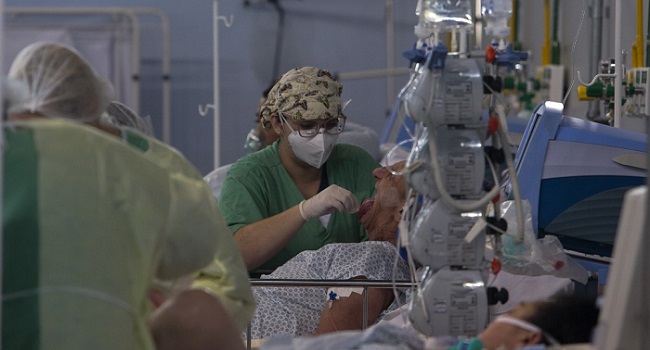
by the COVID-19 coronavirus is treated at a field hospital set up
at a sports gym, in Santo Andre, Sao Paulo state, Brazil, on May
11, 2020. Miguel SCHINCARIOL / AFP.
Scientists worldwide are racing to develop and test a vaccine
for the virus. There are more than 150 projects so far.
But there are no guarantees in the high-stakes race.
Brazil has a deal to make up to 100 million doses of the Oxford
vaccine if it proves effective.
But if it doesn’t, said Levi, “it will all go in the
garbage.”
AFP
Read more https://swordpress.com.ng/2020/07/31/brazil-doctors-volunteer-to-test-coronavirus-vaccines/