
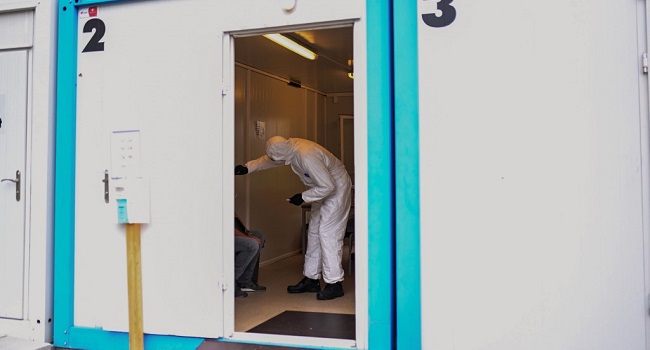
sample of a man at a newly established Corona testing station in
Dortmund, western Germany, on August 1, 2020, amid the new
coronavirus COVID-19 pandemic. – The state government is setting up
test centres for the corona virus for people returning from their
holidays form high-risk areas. (Photo by Ina FASSBENDER /
AFP)
The World Health Organization on Saturday warned the coronavirus
pandemic was likely to be “lengthy” after its emergency committee
met to evaluate the crisis six months after sounding the
international alarm.
The committee “highlighted the anticipated lengthy duration of
this COVID-19 pandemic”, the WHO said in a statement, and warned of
the risk of “response fatigue” given the socio-economic pressures
on countries.
The panel gathered Friday for the fourth time over the
coronavirus crisis, half a year on from its January 30 declaration
of a public health emergency of international concern (PHEIC) — the
WHO’s highest level of alarm.

across the country, as of July 31, 2020. Designer: Benjamin
Oluwatoyin/Channels TV
“WHO continues to assess the global risk level of COVID-19 to be
very high,” said its latest statement.
“The committee highlighted the anticipated lengthy duration of
this COVID-19 pandemic, noting the importance of sustained
community, national, regional, and global response efforts.”
The novel coronavirus has killed at least 680,000 people and
infected at least 17.6 million since the outbreak emerged in China
last December, according to a tally from official sources compiled
by AFP.
Unsurprisingly, the panel, comprising 18 members and 12
advisers, unanimously agreed that the pandemic still constituted a
PHEIC.
Crisis fatigue warning
Several countries around the world have imposed strict lockdowns
in a bid to control the spread of the respiratory disease, plunging
economies into sharp contraction.
The committee urged the WHO to provide nuanced, pragmatic
guidance on COVID-19 reactions “to reduce the risk of response
fatigue in the context of socio-economic pressures”.

July 10, 2020 A photo shows vaccines in prefilled, single-use
syringes before the inspection and packaging phase at the French
pharmaceutical company Sanofi’s world distribution centre in Val de
Reuil, France. Pharma giants Sanofi and GSK said on July 29, 2020,
that they have agreed to supply Britain with up to 60 million doses
of a potential COVID-19 vaccine. The agreement covers a vaccine
candidate developed by France’s Sanofi in partnership with the UK’s
GSK and is subject to a “final contract”.JOEL SAGET /
AFP
The panel urged the WHO to support countries in preparing for
the rollout of proven therapeutics and vaccines.
The committee also urged the agency to accelerate research into
the remaining “critical unknowns” of the virus, such as the animal
source and potential animal reservoirs.
(adsbygoogle = window.adsbygoogle || []).push({});
It called for improved understanding of the epidemiology and
severity of COVID-19, including its long-term health effects.
And the committee wanted more light shed on the dynamics of the
virus, such as “modes of transmission, shedding, potential
mutations; immunity and correlates of protection”.
The near six-hour gathering was hosted at the WHO’s headquarters
in Geneva, with some participants joining via video-link.
The committee will reconvene in three months’ time.

preventive measure against the spred of the COVID-19 coronavirus as
he queues outside Makro in Soweto, Johannesburg, on March 24, 2020.
– South African President Cyril Ramaphosa on March 23, 2020
announced a 21-day national lockdown to start later this week to
contain the spread of the COVID-19 coronavirus which has affected
more than 400 people and ordered the military to enforce the ban.
(Photo by MARCO LONGARI / AFP)
Effects ‘felt for decades’
Going into the meeting, WHO chief Tedros Adhanom Ghebreyesus
said the pandemic’s effects would be long-lasting.
“It’s sobering to think that six months ago, when you
recommended I declare a PHEIC, there were less than 100 cases and
no deaths outside China,” he said Friday.
“The pandemic is a once-in-a-century health crisis, the effects
of which will be felt for decades to come.”
The WHO has been sharply criticised for the length of time it
took to declare an international emergency.

facemasks exchange flower garlands as part of a traditional ritual
of their social marriage funtion, during a lockdown imposed by the
state government against the surge in COVID-19 coronavirus cases,
in Kolkata on July 29, 2020. (Photo by Dibyangshu SARKAR /
AFP)
The United States, which accused the organisation of being too
close to China, officially began its withdrawal from the
organisation in July.
The agency has also been criticised for recommendations deemed
late or contradictory, in particular on wearing masks, or the modes
of transmission of the virus.
“Many scientific questions have been resolved; many remain to be
answered,” Tedros said Friday.
“Most of the world’s people remain susceptible to this virus,
even in areas that have experienced severe outbreaks.”
-AFP
Read more https://swordpress.com.ng/2020/08/02/expect-lengthy-coronavirus-pandemic-who-warns/