
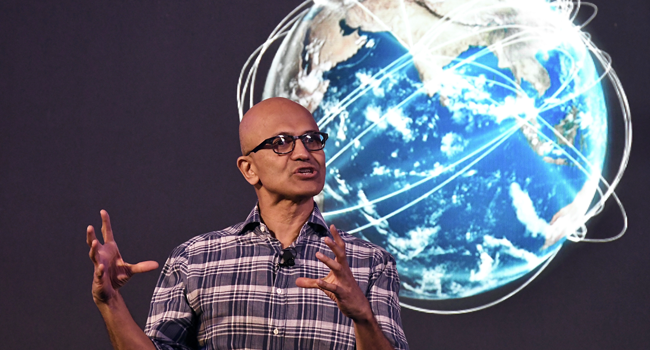
February 25, 2020 Microsoft Corporation Chief Executive Officer,
Satya Nadella, gestures as he addresses the Future Decoded Tech
Summit in Bangalore. Manjunath Kiran / AFP
Microsoft announced Sunday it would continue talks to
acquire the US operations of popular video-sharing app TikTok,
after meeting with President Donald Trump who seemingly backed off
his earlier threats to ban the Chinese-owned platform.
“Following a conversation between Microsoft CEO Satya Nadella
and President Donald J Trump, Microsoft is prepared to continue
discussions to explore a purchase of TikTok in the United States,”
the company said in a statement, acknowledging the “importance of
addressing the President’s concerns” over national security.
Microsoft added that it would continue negotiations with
ByteDance, TikTok’s Chinese parent company, with the intention of
“completing these discussions no later than September 15.”
The statement came after Trump on Friday said he would ban the
app, which is especially popular with young audiences who create
and watch its short-form videos and has an estimated one billion
users worldwide.
TikTok should be sold or blocked in the US, Treasury Secretary
Steven Mnuchin told ABC earlier Sunday, while Secretary of State
Mike Pompeo said on Fox News the president would “take action in
the coming days with respect to a broad array of national security
risks that are presented by software connected to the Chinese
Communist Party.”
TikTok denies it could be a tool for Chinese intelligence, with
its US general manager Vanessa Pappas declaring Saturday: “We’re
not planning on going anywhere.”
‘Biggest loser’
“The United States would be the biggest loser if it banned
TikTok,” Daniel Castro, vice president of the think tank
Information Technology & Innovation Foundation, said Saturday.
“All of its data centers are outside of China, and there is no
evidence that it presents a national security threat.”
taken on November 21, 2019, the logo of the social media video
sharing app Tiktok is displayed on a tablet screen in Paris. (Photo
by Lionel BONAVENTURE / AFP)
Trump said he would use an executive order to ban TikTok, or the
International Emergency Economic Powers Act, a law granting the
president powers to regulate international trade in the face of an
“unusual and extraordinary threat” from abroad to US foreign
policy, national security or the economy.
(adsbygoogle = window.adsbygoogle || []).push({});
His threat has caused great concern for US TikTok users,
particularly content creators who make money on the platform.
Many of them have posted links to their Instagram or YouTube
accounts so as not to lose followers if the platform is ultimately
blocked.
In its statement, Microsoft said it plans to “build on the
experience TikTok users currently love, while adding world-class
security, privacy, and digital safety protections.”
Buying TikTok would give Microsoft a chance to break into the
social networking market.
The IT group currently owns the professional networking platform
LinkedIn, and Teams, an internal messaging service for
companies.
‘Bizarre’
Pappas promised Saturday to create 10,000 US jobs at TikTok over
the next three years, in addition to the 1,500 current
employees.
“Don’t fall for this,” responded senior Trump aide Peter
Navarro, a fierce China critic and a main architect of the trade
war with Beijing.

pictures created on August 01, 2020 shows the logo of the social
media video sharing app Tiktok displayed on a tablet screen in
Paris, and US President Donald Trump at the White House in
Washington, DC, on July 30, 2020. JIM WATSON, Lionel BONAVENTURE /
AFP
“China has hired a whole bunch of American lobbyists. They put a
puppet CEO in charge of that company,” he told Fox News, referring
to former Disney executive Kevin Mayer, who became the CEO of
TikTok in May.
On Friday evening Trump indicated he opposed a takeover of
TikTok by an American company, a solution nevertheless agreed to by
most of the involved parties, including ByteDance, according to The
New York Times.
“This is getting bizarre. A 100 percent sale to an American
company… mitigates any reasonable data protection concerns,”
tweeted Alex Stamos, a former Facebook head of security and a
researcher at Stanford University.
“If the White House kills this (sale) we know this isn’t about
national security,” he added.
AFP