
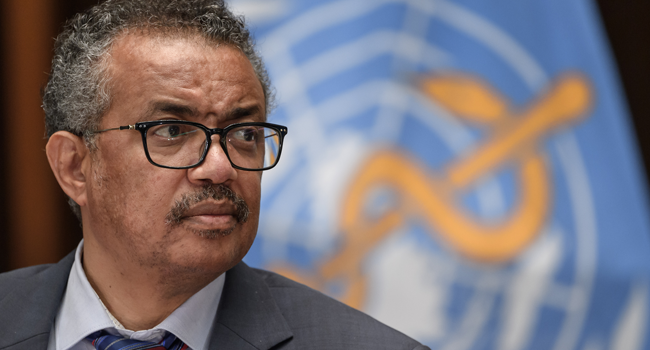
Organization (WHO) Director-General Tedros Adhanom Ghebreyesus
attends a press conference organised by the Geneva Association of
United Nations Correspondents (ACANU) amid the COVID-19 outbreak,
caused by the novel coronavirus, on July 3, 2020 at the WHO
headquarters in Geneva.Fabrice COFFRINI / POOL /
AFP-19
The World Health Organization on Thursday warned against
“vaccine nationalism,” saying vaccine-hogging richer countries
would not be safe coronavirus havens if poor nations remained
exposed.
WHO chief Tedros Adhanom Ghebreyesus said it would be in
wealthier nations’ interests to ensure that any vaccines eventually
produced to protect against the new coronavirus were shared
globally.
“Vaccine nationalism is not good, it will not help us,” Tedros
told the Aspen Security Forum in the United States, via video-link
from the WHO’s headquarters in Geneva.
“For the world to recover faster, it has to recover together,
because it’s a globalised world: the economies are intertwined.
Part of the world or a few countries cannot be a safe haven and
recover.
“The damage from COVID-19 could be less when those countries
who… have the funding commit to this.”

18, 2020, a syringe is pictured on an illustration representation
of COVID-19, the disease caused by the novel coronavirus in Paris.
JOEL SAGET / AFP
He said the existence of the deadly respiratory disease anywhere
put lives and livelihoods at risk everywhere.
“They are not giving charity to others: they are doing it for
themselves, because when the rest of the world recovers and opens
up, they also benefit.”
– Race for the vaccine –
The United Nations health agency also said that multiple
different types of vaccines would likely be needed to combat
COVID-19.
Twenty-six candidate vaccines are in various stages of being
tested on humans, with six having reached Phase 3 wider levels of
clinical trials.
“Phase 3 doesn’t mean nearly there,” explained the WHO’s
emergencies director Michael Ryan.
“Phase 3 means this is the first time this vaccine has been put
into the general population, into otherwise healthy individuals, to
see if the vaccine will protect them against natural infection.
“We’ve got a good range of products across a number of different
platforms, across a number of different countries,” he said of the
leading candidate vaccines, which use different methods to provide
immunity.
(adsbygoogle = window.adsbygoogle || []).push({});
However, “there’s no guarantee that any of these six will give
us the answer — and we probably will need more than one vaccine to
do this job.
– ‘Americas remain epicentre’ –
The novel coronavirus has killed over 708,000 people and
infected more than 18.8 million since the outbreak emerged in China
last December, according to a tally from official sources compiled
by AFP.
“The Americas remain the current epicentre of the virus and have
been particularly hit hard,” said Tedros, with the United States,
Brazil and Mexico suffering the most deaths.
Asked about the virus raging in the Americas, Ryan said no
country had always found all the right answers, and a vast
expansion of the public health workforce was required.
“We need to take a step back, we need to look at the problem
again and we need to go at the problem again,” he said.
“That requires strong, sustained and trusted leadership.”
US President Donald Trump has accused the WHO of being a
“puppet” of China and mismanaging its handling of the global
pandemic.
Washington last month handed in its 12-month notice to leave the
WHO, depriving the UN organisation of its biggest donor.
Tedros said the biggest “problem” with the US departure was “not
about the money” but the fracture in international solidarity in
fighting the virus.
“We hope the US will reconsider its position,” he said.
The Ethiopian former health minister claimed any problems
Washington had with the WHO could be resolved without the US
leaving.
“I hope the relationship will return to normal and be a stronger
relationship than ever before,” he said.
“I urge all leaders to choose the path of cooperation… it’s the
only choice we have.”
AFP
Read more https://swordpress.com.ng/2020/08/07/vaccine-nationalism-cannot-beat-covid-19-says-who/