
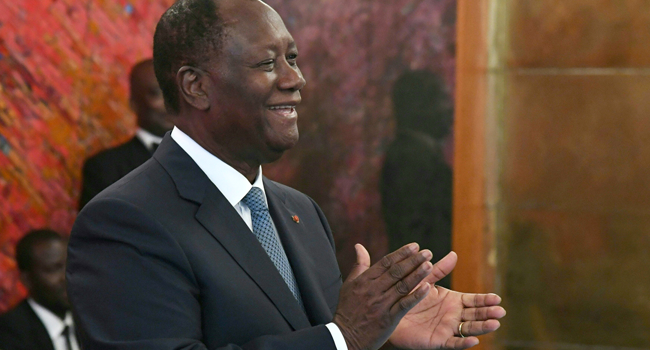
2019 shows Ivory Coast President Alassane Ouattara applauding
during a ceremony at the presidential palace in Abidjan. ISSOUF
SANOGO / AFP
Ivory Coast President Alassane Ouattara’s decision to
run for a third term in October’s presidential election triggered
outrage on Friday among opposition and civil society groups, who
labelled it a “coup” that risked tipping the country into
chaos.
Ouattara, in power since 2010, said in March that he would not
run for re-election, which the opposition has strongly maintained
he was unable to do anyway because the constitution limits
presidents to two terms.
But the race was turned on its head by the sudden death of prime
minister Amadou Gon Coulibaly — seen as Ouattara’s anointed
successor — from a heart attack in July.
The shock news ramped up the volatility for the tense October 31
vote, which takes place in the shadow cast by political violence
following 2010’s election in which around 3,000 people died.
Ouattara said on Thursday that he would run after all, citing “a
case of force majeure” after the death of his ruling RHDP party’s
candidate Coulibaly “left a void”.
The constitution limits presidents to two five-year terms.
But a new constitution was adopted in 2016, which Ouattara and
his supporters argue reset the clock, allowing him to run again —
an interpretation strongly contested by the opposition.
Assoa Adou, the general secretary of the Ivorian Popular Front
(FPI), one of the country’s two main opposition parties, said:
“Alassane Ouattara cannot in any case stand in the election. His
own experts have said so.”
‘Organised state coup’
N’Goran Djedri of the West African country’s largest opposition
party PDCI said Ouattara “is not above the law”.
“The people of Ivory Coast must demand the exact application of
the 2016 constitution, which stipulates in article 183 that the
legislation currently in force remains applicable.”
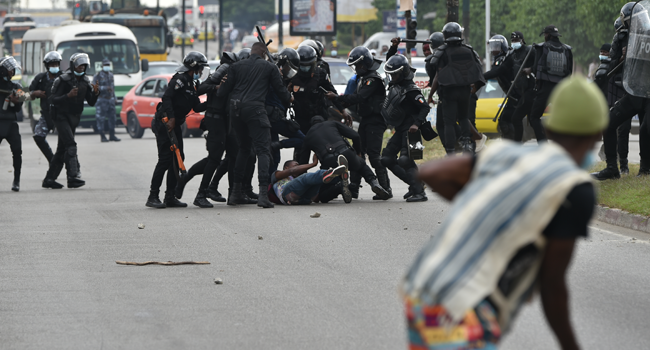
during a rally of former Ivory Coast President Laurent Gbagbo’s
supporters to protest against his absence on the presidential
candidates electoral list, near the elec toral commission
headquarters on boulevard Latrille in Cocody district of Abidjan on
August 6, 2020. SIA KAMBOU / AFP
(adsbygoogle = window.adsbygoogle || []).push({});
Moussa Toure, the communications director of presidential
candidate and former prime minister Guillaume Soro, said: “We are
facing an organised state coup in the sense that Mr Ouattara’s plan
constitutes a serious violation” of the constitution.
“His decision to run for a third term takes us back 10 years and
risks plunging Ivory Coast back into a period of fear, division and
chaos,” Toure added.
It was not just opposition parties expressing outrage.
“By succumbing to the temptation of political eternity, you risk
driving Ivory Coast into chaos,” popular Ivorian singer Meiway
said on social media. “Are you to sacrifice everything you have
built to put yourself on the wrong side of history?”
Satirical writer Gauz said the “old are not wise, they act like
they’re in a playground,” referring to both 78-year-old Ouattara
and his arch-foe and biggest rival, 86-year-old former president
Henri Konan Bedie of the PDCI.
“It is despairing for the youth who represent four fifths of the
Ivorian population,” Gauz added.
Supporters express ‘immense joy’
The leaders of Ouattara’s ruling RHDP did not respond to
requests to comment on Friday.
But Ouattara did lead a 15-minute ceremony at the presidential
palace on Friday marking the 60th anniversary of Ivory Coast’s
independence, after the celebrations were scaled back due to the
coronavirus pandemic.
After his announcement on Thursday, RHDP supporters
celebrated in the economic capital Abidjan, the second-largest city
of Bouake and Ouattara’s stronghold of Korhogo, according to AFP
journalists and residents.
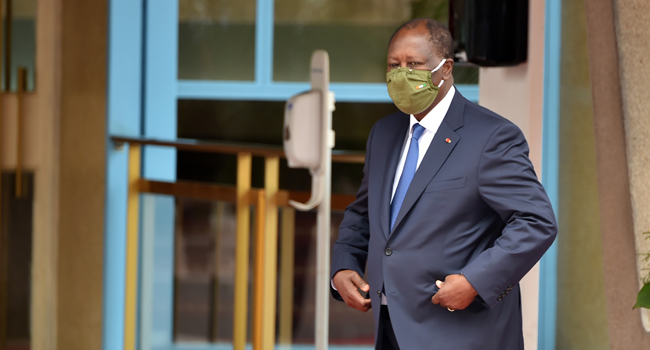
Ouattara wearing a protective mask attends a ceremony to mark the
60th anniversary of the country Independance from France on August
7, 2020 at the presidential palace in Abidjan.SIA KAMBOU /
AFP
“It is an immense joy which animates us. We are going to make
short work of our adversaries” in the election, said Siaka Sylla,
an RHDP youth leader in Bouake.
The election comes after a low-level civil war and political
turmoil that erupted in 2011 when former strongman Laurent Gbagbo
refused to cede power to Ouattara after losing elections. The
ensuing unrest claimed some 3,000 lives.
Besides Ouattara and Bedie, the October election is also being
contested by Gbagbo’s former prime minister Pascal Affi N’Guessan,
former foreign minister Marcel Amon-Tanoh and ex-education minister
Albert Toikeusse Mabri
Former rebel chief Soro is also running but he lives in
self-imposed exile in France, facing a long list of legal
problems.
Gbagbo, freed conditionally by the International Criminal Court
for crimes against humanity over the 2010-2011 bloodshed, has
applied for a passport so that he can return home for the
election.
AFP
Read more https://swordpress.com.ng/2020/08/09/outrage-over-ivory-coast-presidents-third-term-bid/