
 photo
photo
Nomura jellyfish one of the largest in the World ! can weigh up to
200kg
Nomura’s jellyfish is a very large rhizostome jellyfish, in the
same size class as the lion’s mane jellyfish, the largest cnidarian
in the world. It is edible but not considered high quality. It is
the only species in the monotypic genus Nemopilema.
Growing up to 2 m (6.6 ft) in diameter and weighing up
to 200 kg (440 lb),[] Nomura’s jellyfish reside
primarily in the waters between China and Japan, primarily
centralized in the Yellow Sea and East China
Sea.[5] Population blooms appear to be
increasing with frequency in the past 20 years.[6] Possible reasons for the
population increase in Nomura’s Jellyfish include climate change,
overfishing, and coastal modification adding substrate for
asexually producing polyps.[5]
Jellyfish have two main types of muscle: epitheliomuscular cells
and striated muscle cells. Researchers found that gene families
that are closely associated with striated muscle were expressed in
the bell portion of the jellyfish, providing evidence that striated
muscle plays a significant role in jellyfish motility
The animals that can live forever
No one likes the thought of growing old. Despite our many human
endeavours to escape or delay the process of ageing, it seems to be
an inevitable part of life.
But … why? Why do living things gradually fall apart when they
grow older?
There is a word for it: senescence. No, it’s not the rock
band who sang ‘Bring Me to Life’; senescence is the state of
gradual deterioration of normal functioning. At the cellular level,
it means cells stop dividing and they eventually die. It can also
apply to an entire organism (where a living thing can no longer
respond adequately to outside stressors), or to specific organs or
tissues (like leaves dying and falling from trees in
autumn).
While there are ways we can slow down (or speed up) the rate at
which senescence occurs, it is still going to happen one way or
another. However, a few species can escape the ageing process
completely.
The ‘immortal’ jellyfish, Turritopsis
dohrnii
To date, there’s only one species that has been called
‘biologically immortal’: the jellyfish Turritopsis
dohrnii. These small, transparent animals hang out in oceans
around the world and can turn back time by reverting to an earlier
stage of their life cycle.
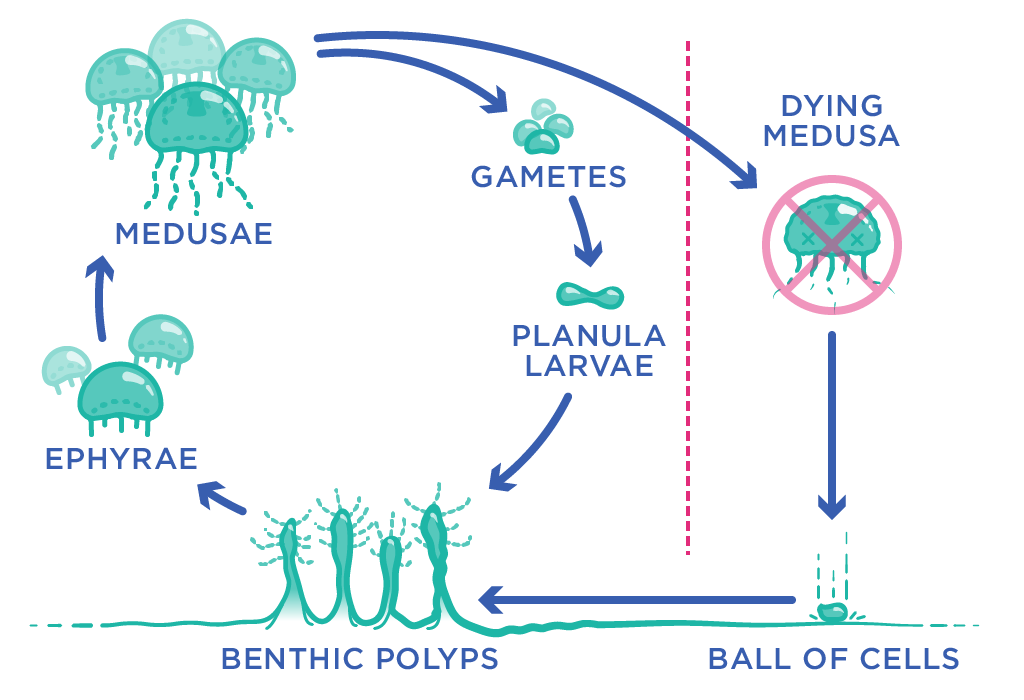
adapted from: Australian Academy of Science
A new jellyfish life begins with a fertilised egg, which grows
into a larval stage called a planula. After a quick swim, the
planula latches onto a surface (like a rock, or the ocean floor, or
a boat’s hull), where it develops into a polyp: a tube-shaped
structure with a mouth at one end and a kind of ‘foot’ at the
other. It remains stuck in place for some time, growing into a
little colony of polyps that share feeding tubes with each
other.
Eventually, depending on the jellyfish species, one of these
polyps will form an outgrowth called a ‘bud’, or it may produce
separate segments stacked on top of one another, that can then
break away from the rest of the colony. This process is responsible
for the next stages of the jellyfish life cycle: the ephyra (a
small jellyfish) and the medusa, which is the fully-formed adult
stage capable of sexual reproduction.
For most other jellyfish, this stage is the end of the line.
But Turritopsis dohrnii (and possibly some
other jellyfish species too) has a neat party trick: when it
faces some kind of environmental stress, like starvation or injury,
it can revert back to being a tiny blob of tissue, which then
changes back into the sexually immature polyp phase of life. It is
a bit like a butterfly turning back into a caterpillar, or a frog
becoming a tadpole again.
(adsbygoogle = window.adsbygoogle || []).push({});
Of course, Turritopsis dohrnii isn’t truly
‘immortal’. They can still be consumed by predators or killed by
other means. However, their ability to switch back and forth
between life stages in response to stress means that, in theory,
they could live forever.
Hydra
Hydra look a bit similar to the polyp stage of a
jellyfish (which makes some sense, given that jellyfish
and Hydra are grouped together in the phylum
Cnidaria): a tubular body with a tentacle-ringed mouth at one end
and an adhesive foot at the other. They’re very simple animals that
spend their days mostly staying in one place in freshwater ponds or
rivers and using their stinging tentacles to grab any prey that
happens to swim past.
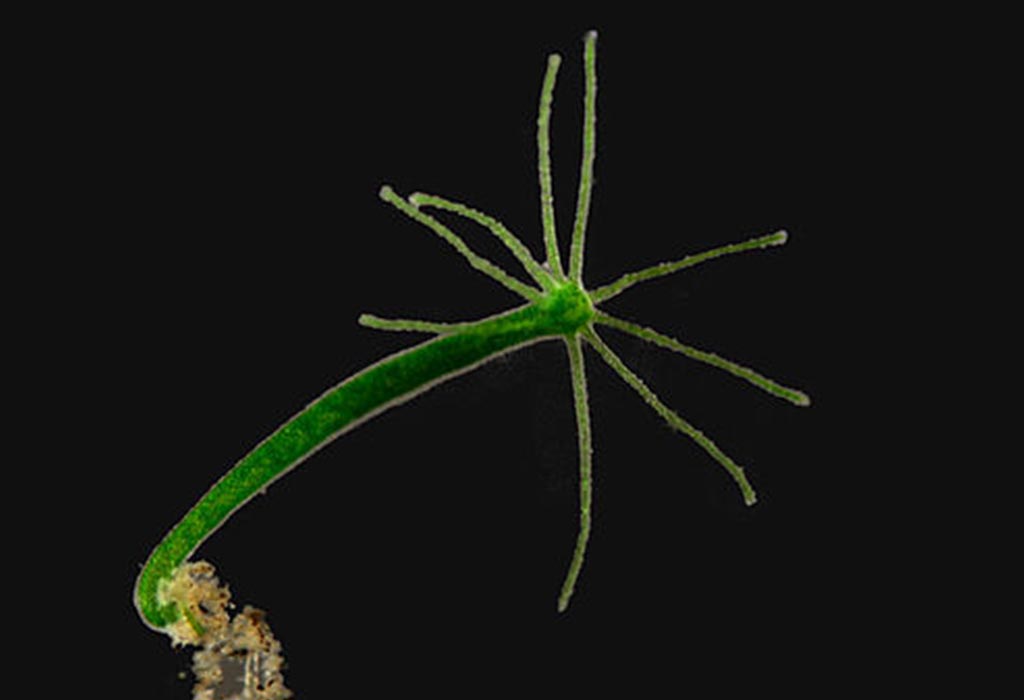
adapted from: Frank Fox; CC BY-SA 3.0 DE
Their claim to immortality? It seems as though they
don’t go through senescence at all. Instead of gradually
deteriorating over time, a Hydra’s stem cells
have the capacity for infinite self-renewal. This seems to be
thanks to a particular set of genes called FoxO genes, which
are found in animals from worms to humans and play a role in
regulating how long cells will live for.
In the case of Hydra’s stem cells, there
seems to be an overabundance of FoxO gene expression. When
researchers prevented FoxO genes from functioning, they found
that Hydra’s cells began to show signs of ageing
and would no longer regenerate as they did before. We still don’t
know exactly how it all works, but we do know that these genes
clearly play an important role in
maintaining Hydra’s endless youthfulness.
Not-quite-immortal lobsters
Lobsters also do not experience senescence.
Unlike Hydra’s reliance on particular genes, however,
their longevity is thanks to them being able to endlessly repair
their DNA.
Normally, during the process of DNA copying and cell division,
the protective end-caps on chromosomes, called
telomeres, slowly get shorter and shorter, and when they are
too short, a cell enters senescence and can no longer keep
dividing.
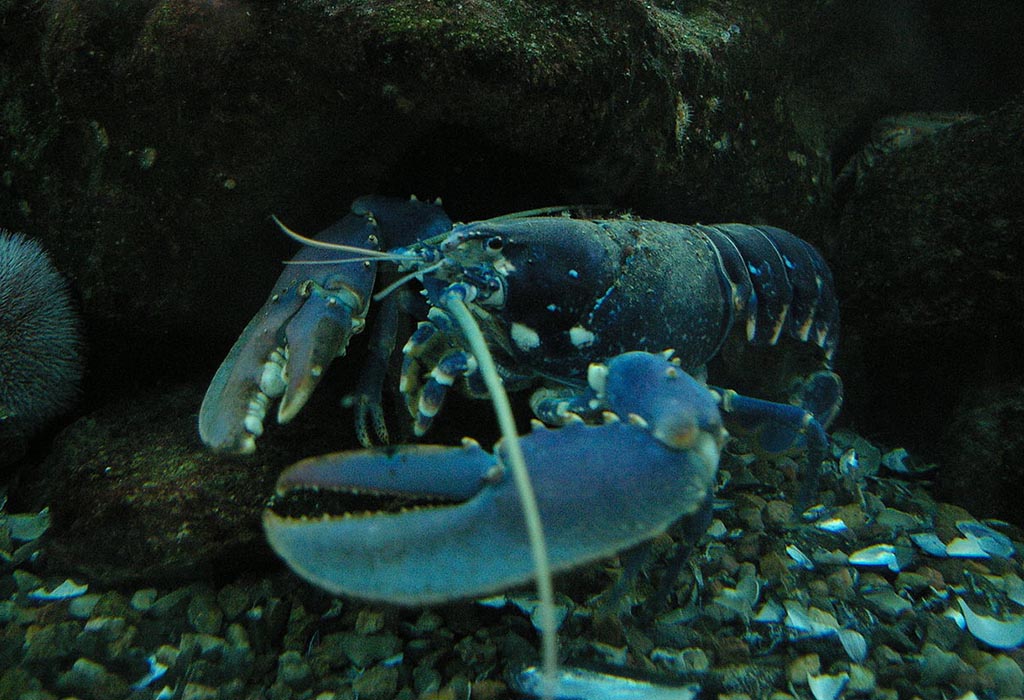
biologically immortal. Image adapted from: Cefaclor
/ Wikipedia; CC BY SA 3.0
Lobsters don’t have this problem thanks to a never-ending
supply of an enzyme called telomerase, which works to keep
regenerating telomeres. They produce lots of this enzyme in all of
their cells throughout their adult lives, allowing them to maintain
youthful DNA indefinitely.
Telomerase is not unique to lobsters. It is present in most
other animals, including humans, but after passing the embryonic
life stage, levels of telomerase in most other cells decline and
are not sufficient for constantly re-building telomeres.
Unfortunately for lobsters though, there’s a catch: they
literally grow too big for their own shells. Lobsters continually
grow larger and larger, but their shells can’t change size, meaning
a lifetime of ditching too-small shells and growing a brand-new
exoskeleton each time. That takes a fair amount of energy.
Eventually, the amount of energy required to moult a shell and grow
another new one is simply too much. The lobster succumbs to
exhaustion, disease, predation or shell collapse.
Forever young?
There are many other animal (and non-animal!) species that offer
tantalising glimpses into an ageless existence: the risk of dying
for naked mole rats appears to not increase as they get
older; the world’s oldest known non-colonial animal,
a remarkably stress-resistant ocean-dwelling quahog clam
named Ming, only died (accidentally) after a good 500
years when researchers dredged it up out of the
ocean and wanted to find out how old it was; incredibly
ancient bristlecone pines seem to function just as
smoothly as much younger trees do; a particular colony of
quaking aspens is considered to be about 80,000 years old …
and there are plenty of other unusually long-lived species that
seem to defy the passing of time.
Do they hold the key to eternal youthfulness for humans, too? We
know that ageing in humans is thanks to a multitude of factors,
many of which we still don’t entirely understand. Perhaps these
examples from other species can shed some more light on those
processes.
jellyfish
A jellyfish has no ears or eyes or nose and no
brain or heart! They do not even have a head. Their body is almost
totally made of water and is soft having no bones at
all. Jellyfish are invertebrate animals because
they do not have a spine or backbone.
10 Cool things you didn’t know about
jellyfish

1. Jellyfish are the oldest multicellular animals on the
planet

Scientists have discovered jellyfish fossil snapshots in rocks
believed to be more than 500 million years old. That makes them
even older than dinosaurs!
2. Jellyfish don’t have brains

They don’t have a heart, lungs or a brain either! So how does a
jellyfish live without these vital organs? Their skin is so thin
that they can absorb oxygen right through it, so they don’t need
lungs. They don’t have any blood so they don’t need a heart to pump
it. And they respond to the changes in their environment around
them using signals from a nerve net just below their epidermis –
the outer layer of skin – that is sensitive to touch, so they don’t
need a brain to process complex thoughts.
3. A jellyfish is called a Medusa

Jellyfish often look like a bell with tentacles all around the
edge or hanging off the bottom. The shape of this bell is called a
medusa because it looks like the evil Medusa in Greek mythology – a
woman who had offended the goddess Athena who then changed her hair
into snakes and made her face so hideous it turned people into
stone. Medusa is also the word for jellyfish in many other
languages including Greek, Hebrew and French.
4. Jellyfish can clone themselves

Imagine if you could just split in half and create a second
version of yourself? If you cut a jellyfish in half, the pieces of
the jellyfish can regenerate and turn into two new jellies.
5. Some jellyfish have teeth

Photo: T3 Media/Nat Geo
The beroid comb jellyfish has hundreds of rows of “teeth” made
of tiny hairs that can pierce, tear and pull their prey into their
stomachs.
6. Jellyfish have gone into space

Photo: Howard Hall
In 1991, moonfish jellyfish travelled into outer space on the
Space Shuttle Columbia so that scientists could examine how
microgravity affected them. The jellyfish multiplied in space. When
they came back to Earth, the scientists discovered that the
space-born jellyfish couldn’t figure out how to deal with
gravity.
7. Jellyfish never get tangled

Even though some jellyfish have very long tentacles, they never
get tangled up or sting them. That’s because the tentacles are very
slippery and only sting other species of jellyfish.
8. Jellyfish can have super long tentacles

CC0 Public Domain
The lion’s mane jellyfish is the world’s largest jellyfish
species. It can have tentacles that are over 27 meters long –
longer than the size of the blue whale which is the biggest mammal
in the world!
9. Jellyfish groups have a really awesome name

You might think that a gaggle of geese, a murder of crows, or a
clowder of cats sounds interesting, but jellyfish groups have even
better names. A group of jellyfish – which can include up to
300,000 jellyfish – is called a “bloom,” a “swarm” or a
“smack.”
10. There’s not much to a jellyfish

Jellyfish are between 85% and 98% water. If they wash up on the
beach they’ll almost disappear as their water evaporates.