
UNITED ARAB EMIRATES POPULATION STATISTICS
(2020)
 No
No
conversation about the UAE is ever complete without talking about
the incredible changes that the country has gone through over the
last few decades. In recent years, the rate of this transformation
has only sped up. We now see an even greater emphasis on
technology, global trade and tourism in the nation’s administrative
policies and international relationships. UAE is emerging as a
global power with an increasing say and influence in world affairs.
As we step into 2020, we reflect on the way the nation’s
population has grown more diverse and how its vibrant expatriate
community (which makes up around 80% of the population) has had a
profound impact on the country’s culture. We will also explore the
many different demographics that make up the population and how
each one of them will shape its future in the coming years.
When researching for this article, we came across many
conflicting figures for the population of the UAE in 2020. We were
looking at data from a host of different institutions, who had used
their own systems and methodologies to arrive at their figures. In
the end, we chose to accept the World Bank figures to be the most
accurate, since their numbers seemed more aligned with the UAE
government’s official figures from 2017.
UAE Population in 2020 is 9.89 Million according to the
data provided by the World Bank. While Dubai
Population in 2020 is 3.38 Million according to official Dubai
Government website.
We have listed out these different figures in the following
table.
Sources |
Population |
Year |
| World Bank |
9,890,000 (9.89) |
2020 |
| CountryMeters.info | 10,080,287 (10.08) |
2020 |
| Worldometers.info | 9,869,948 (9.87) |
2020 |
| Statista.com | 11.08 |
2020 |
| Worldpopulationreview.com | 9,871,439 (9.87) |
2020 |
| PopulationPiramid.net | 9,890,400 (9.89) |
2020 |
| United Nations |
9,890,000 (9.89) |
2020 |
(In the coming weeks we will be exploring UAE’s 2020 population
in detail, from the perspective of the various factors and
demographics that it’s made up of.)
Meanwhile, you can read our 2018 blog examining the elements of
last year’s population figures.
TABLE OF CONTENTS
UAE POPULATION STATISTICS 2018 :
INFOGRAPHIC

Image on your Blog or Website
According to an estimate by the World Bank,
the UAE’s population in 2018 stands at 9.543
million.
Other sources which confirm this estimate include
populationpyramid.com and uae-expatriates.com, while Facebook
Insights reveal that the potential reach of the platform in the UAE
in the third quarter of 2017 was 9.3 million. We can safely assume
that the population of the UAE in 2018 stands at around 9.54
million.
The Federal Competitiveness and Statistics Authority (FCSA) had
published the that UAE population according to administrative
records until 31 December 2016 was 9,121,167 (9.12
million).
FSCA is a government-backed agency formed to improve UAE’s data
and competitiveness capabilities. FCSA claims that the population
figures for 2016 are highly accurate and up-to-date. The population
figures were derived with the support and collaboration of several
national partners and other stakeholders. The last official census
of UAE was conducted in the year 2005, with the population numbers
pegged at 4.1 million. The official UAE government website
announced that the population stood at 4.8 million in 2008, which
indicates that there has been a double-fold increase in the
population in a span of 10 years.
UAE Population Statistics by Year (Historical
population)
Year |
Population |
| 2020 | 9.89 million |
| 2019 | 9.77 million |
| 2018 | 9.54 million |
| 2017 | 9.40 million |
| 2016 | 9.27 million |
| 2015 | 9.15 million |
| 2014 | 9.07 million |
| 2013 | 9 million |
| 2012 | 8.90 million |
| 2011 | 8.67 million |
| 2010 | 8.27 million |
Male vs Female Population of the UAE in
2018
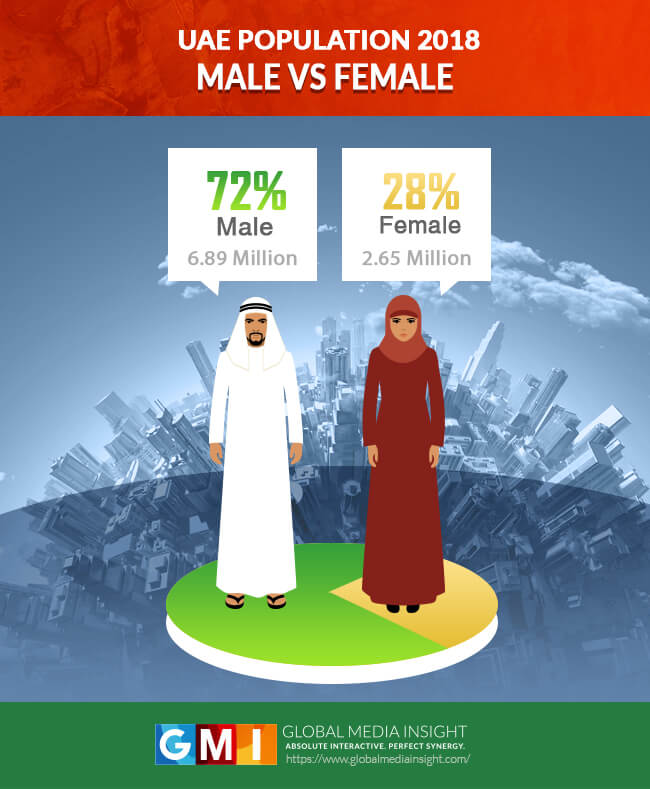 According to our research, in
2018, males make up 72% of the UAE population at
6.89 million while the number of females account for only
28% of the total UAE population at 2.65 million. That
makes the gender split at 72% male – 28% female.
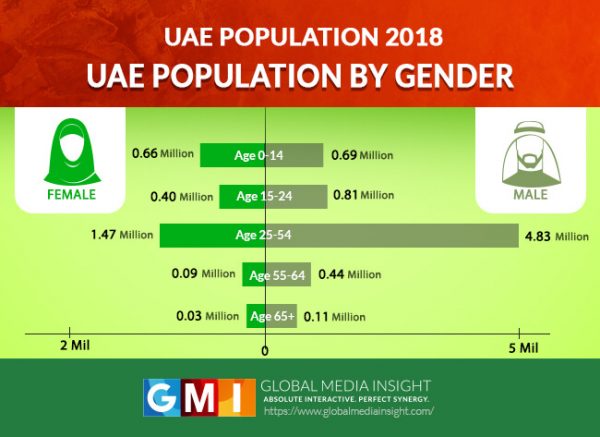
Men outnumber women in all age groups as mentioned in the above
infographic. However, the number of males and females in age group
0 to 14 are almost equal. The number of men under the age group 15
to 24 is double that of women in the same age group. The most
significant difference, gender-wise, is seen in age group 25 to 54.
There are 4.83 million men within this age group in the UAE whereas
the number of women within this age group is just 1.46 million.
Demographics of the United Arab Emirates
The life expectancy in the UAE has been on a steady rise. The
majority of the population falls into the 25-54 age bracket, again
indicating that immigrants and expats make up a large chunk of
UAE’s population.
Age-wise population of the UAE
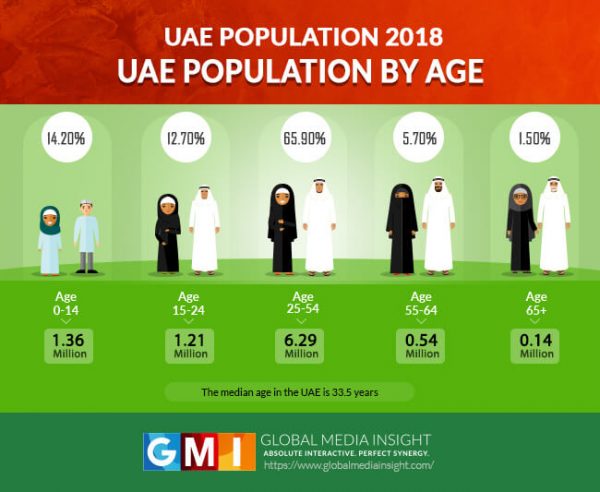
Majority of the UAE population falls in the age group of 25 to
54 years. A large part of this can be attributed to the expatriate
population of working men and women who fall in this age
category.
The median age for Dubai is 33.5 years.
(Source: populationpyramid.net)
Age-wise Population of the UAE
| Age Group | Women | Men | Total |
| 0-14 years | 0.67 million | 0.69 million | 1.36 million |
| 15-24 years | 0.40 million | 0.81 million | 1.21 million |
| 25-54 years | 1.46 million | 4.83 million | 6.29 million |
| 55-64 years | 0.09 million | 0.45 million | 0.54 million |
| 65 years and over | 0.03 million | 0.11 million | 0.14 million |
Expatriate Population of the UAE in 2018
As stated previously in this article, expatriates
and immigrants account for 88.52%. Emiratis make up
remaining 11.48% of the population. 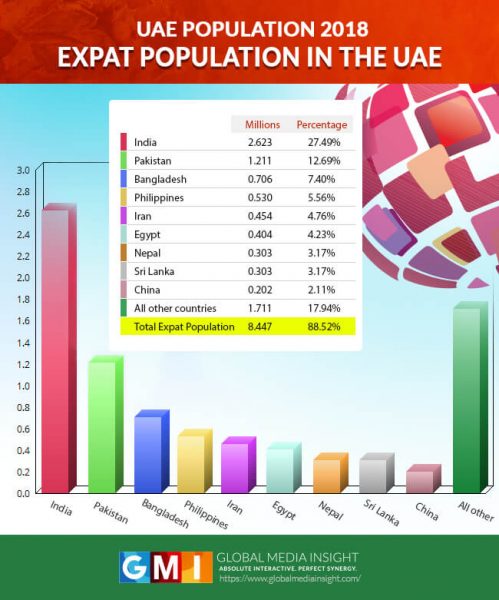 South Asians, which include people from India, Bangladesh,
Pakistan and other South Asian nations, compose 59.48% of the
population. The rest of population comprises of Egyptians at 4.23%
and others at 17.94%. The UAE government’s population strategy
envisions in making the Emiratis the majority community or at least
bringing the numbers up to 40% by the year 2021. 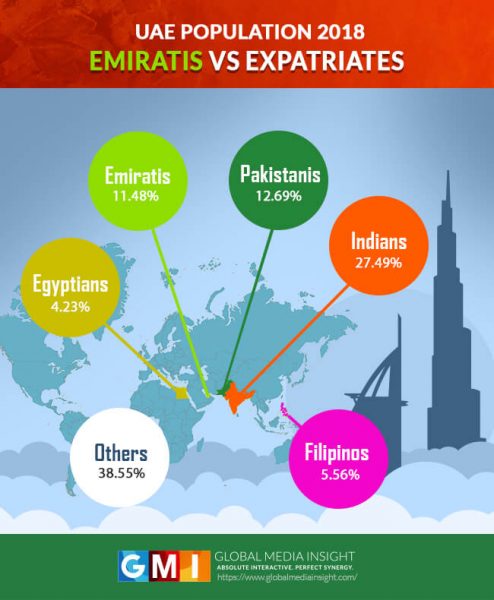 UAE Population by Nationality
(Expat population of UAE in 2018 )
Nationality |
Population |
| India | 2.62 million |
Pakistan |
1.21 million |
Bangladesh |
0.71 million |
Philippines |
0.53 million |
| Iran | 0.45 million |
| Egypt | 0.40 million |
| Nepal | 0.30 million |
| Sri Lanka |
0.30 million |
| China | 0.20 million |
All other countries |
1.71 million |
Total Expat Population |
8.45 million |
Digitization and Economic Status of the
UAE
The UAE features among the top “adopter” economies in terms of
connectivity within the Arab world according to Huawei’s Global
Connectivity Index (GCI) 2017. The report analyzed 50 countries, of
which 16 were considered as front-runners, 21 as adopters, while
the remaining 13 as starters. Front-runners mostly comprise of
developed nations, Adopters have an average GDP per capita of
$15,000 and starters are countries with an average GDP capita of
$3,000. Adopters focused on increasing ICT demand and working
towards digitization and economic growth.
Most popular Social Media Platforms in the
UAE
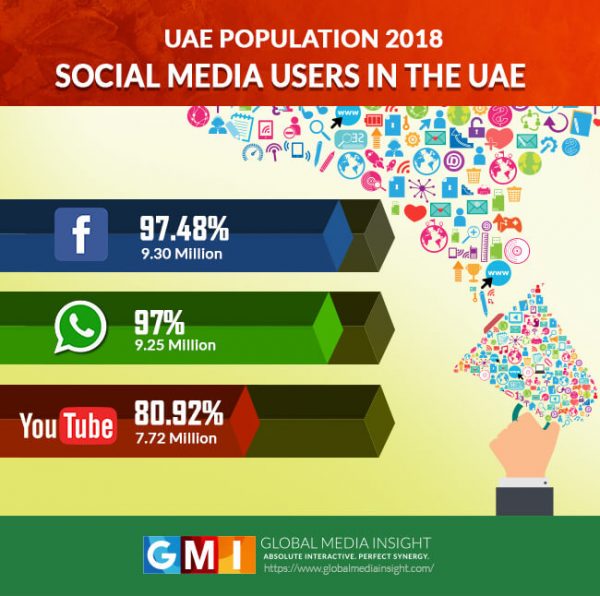
Facebook is the most popular social media in the UAE with 97.48%
of population using the social media platform.
WhatsApp is the most popular messenger app in the UAE with 97%
of people in UAE using WhatsApp.
YouTube users in the UAE have also increased compared to
previous year. According to Adwords insights, 80.92% of the
UAE population (7.72 million) uses YouTube.
EMIRATE-WISE POPULATION
Nearly 75% of the population of UAE is concentrated on the
northeast of the country. The two biggest cities Dubai and Abu
Dhabi have more than 3 million residents each. Dubai, with the
busiest port in the region, is the commercial capital of the
country. Some of the biggest companies in the world have their
headquarters in the city.
(adsbygoogle = window.adsbygoogle || []).push({});
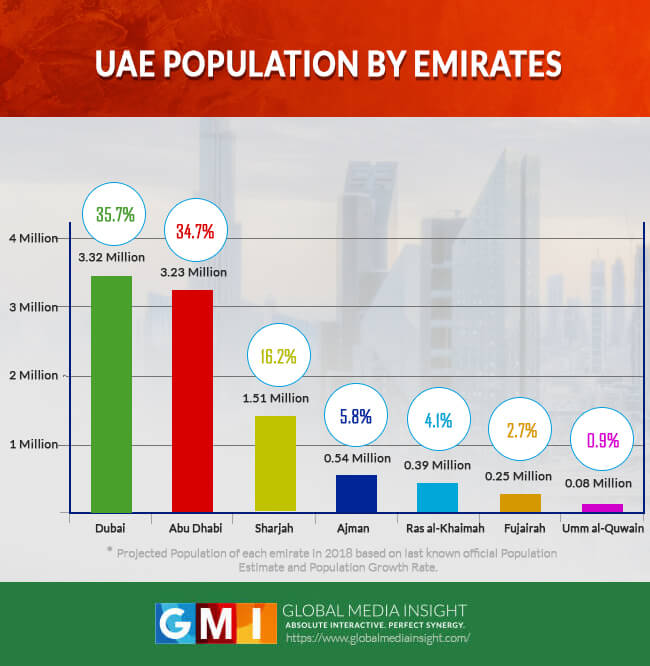
Abu Dhabi is the capital of the country. The city houses federal
government offices and serves as the seat of the UAE Government.
Nearly 95% of the oil and 92% of the gas in the country are in this
Emirate, making it the wealthiest Emirate. When considering other
entries in the list of city wise population distribution of UAE,
Sharjah emerges a distant third from the big two with 1.51 million
people. Sharjah’s close proximity to Dubai and much lower living
costs can be attributed as reasons for its growth.
Population of Each Emirate in UAE (2018)
Emirate |
Population (2018) |
| Abu Dhabi |
3.23 million |
| Ajman | 0.54 million |
Fujairah |
0.25 million |
| Sharjah | 1.51 million |
| Dubai | 3.33 million |
| Ras al-Khaimah |
0.39 million |
| Umm al-Quwain |
0.08 million |
How We Arrived At These Figures
The emirate-wise population mentioned here is projected from the
last known official population figures released by the UAE
government. Several other factors, including the historical
population growth rate available from official records as well as
events in these emirates which might influence the observed
population growth were taken into account before arriving at the
final population of each emirate.
The UAE government has conducted 4 censuses since the very first
one 1980. when the last census was done in 2005, Abu Dhabi was the
emirate with the most population. Since then, Dubai has grown
rapidly to become the most populated city in UAE. This is reflected
in the latest estimates by the UAE government. The government
arrives at these population figures from the citizen and
immigration records that it maintains.
Refer below graphs to compare the population change in each
emirate.
Population of Abu Dhabi
Year |
Source |
Population |
| 1980 | Census | 451,848 |
| 1985 | Census | 566,036 |
| 1995 | Census | 942,463 |
| 2005 | Census | 1,399,484 |
| 2010 | Official Estimate |
1,967,659 |
| 2015 | Official Estimate |
2,784,490 |
| 2016 | Official Estimate |
2,908,173 |
| 2017 | *GMI Estimate |
3,071,031 |
| 2018 | *GMI Estimate |
3,233,888 |
The oil boom of the 80s coincided with a massive population
growth in Abu Dhabi between 1980 and 2005. The city’s population
now shows a steady increase over the last decade, edging over 3
million in 2017. 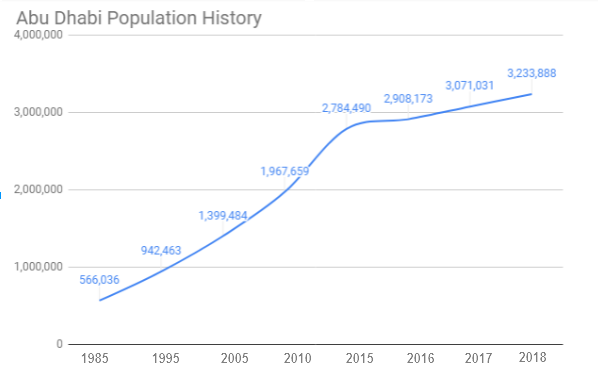
Population of Dubai
Year |
Source |
Population |
| 1980 | Census | 276,301 |
| 1985 | Census | 370,788 |
| 1995 | Census | 689,420 |
| 2005 | Census | 1,321,453 |
| 2010 | Official Estimate |
1,837,610 |
| 2015 | Official Estimate |
2,383,017 |
| 2016 | Official Estimate |
2,566,209 |
| 2017 | Official Estimate |
2,976,455 |
| 2018 | *GMI Estimate |
3,327,677 |
| 2019 | *GMI Estimate |
3,350,000 |
| 2020 | *GMI Estimate |
3,384,000 |
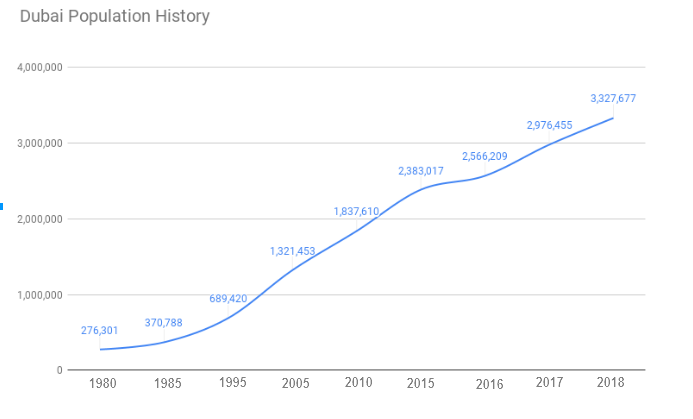
This global hub for transport and business continues to grow
exponentially every year. The population of the city has nearly
tripled in the last 20 years making it UAE’s most populous city in
2018.
Population of Sharjah
Year |
Source |
Population |
| 1980 | Census | 159,317 |
| 1985 | Census | 228,317 |
| 1995 | Census | 402,792 |
| 2005 | Census | 793,573 |
| 2010 | Official Estimate |
1,060,000 |
| 2015 | Official Estimate |
1,405,843 |
| 2016 | Official Estimate |
1,432,942 |
| 2017 | Official Estimate |
1,460,042 |
| 2018 | *GMI Estimate |
1,514,240 |
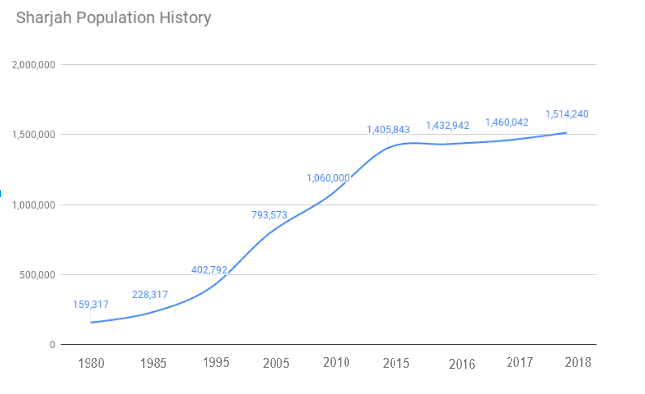
Even though it has a rich history that is more than 5000 years
old, Sharjah is now considered an extension of Dubai. The city is
part of the Sharjah-Ajman-Dubai urban zone.
Population of Ajman
Year |
Source |
Population |
| 1980 | Census | 36,100 |
| 1985 | Census | 54,546 |
| 1995 | Census | 121,491 |
| 2005 | Census | 206,997 |
| 2010 | Official Estimate |
263,000 |
| 2015 | Official Estimate |
512,285 |
| 2016 | *GMI Estimate |
519,201 |
| 2017 | *GMI Estimate |
526,117 |
| 2018 | *GMI Estimate |
539,948 |
The Emirate of Ajman forms a contiguous urban area with the
Emirates of Dubai and Sharjah. In the 1980s Ajman was a small town
with a population under one hundred thousand . Now it has grown
manifold into a big city with over five hundred thousand
people. 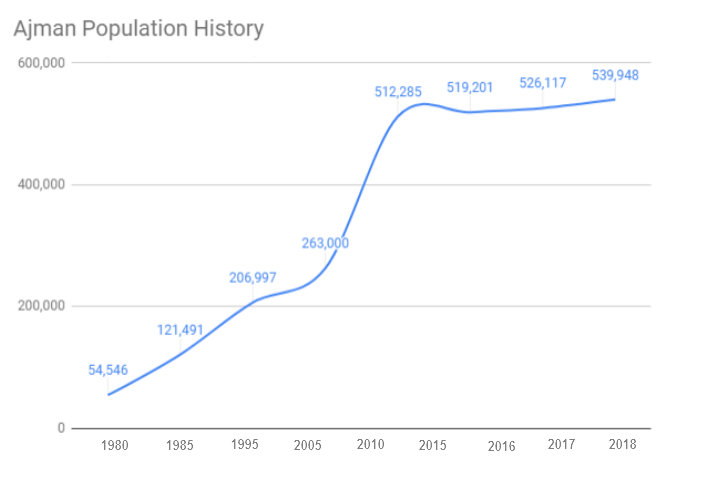
Population of Fujairah
Year |
Source |
Population |
| 1980 | Census | 36,100 |
| 1985 | Census | 54,546 |
| 1995 | Census | 121,491 |
| 2005 | Census | 206,997 |
| 2010 | Official Estimate |
263,000 |
| 2015 | Official Estimate |
512,285 |
| 2016 | Official Estimate |
519,201 |
| 2017 | Official Estimate |
526,117 |
| 2018 | *GMI Estimate |
539,948 |
Known for its beaches, Hajar mountains and the Sheikh Zayed
Mosque, the Emirate for Fujairah underwent a population explosion
in the 90s. The population of the Emirate is mainly employed in the
cement, stone crushing and mining industries. 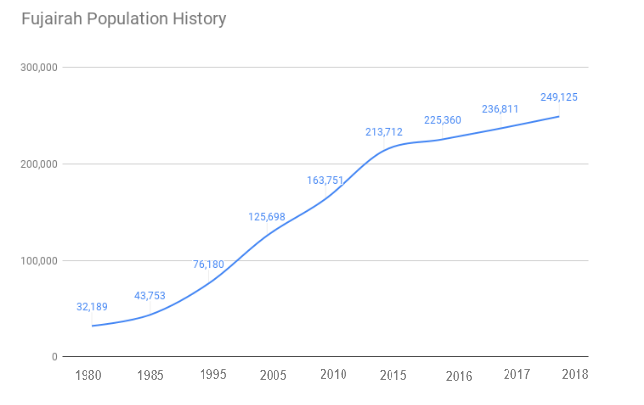
Population of Ras al-Khaimah
Year |
Source |
Population |
| 1980 | Census | 73,918 |
| 1985 | Census | 96,578 |
| 1995 | Census | 143,334 |
| 2005 | Census | 210,063 |
| 2010 | Official Estimate |
277,532 |
| 2015 | Official Estimate |
345,000 |
| 2016 | *GMI Estimate |
355,350 |
| 2017 | *GMI Estimate |
365,700 |
| 2018 | *GMI Estimate |
386,400 |
The northern-most Emirate of Ras Al Khaimah has a high
percentage of Emirati citizens in their population. The main
sources of employment in this Emirate are the cement industry and
the agriculture sector. 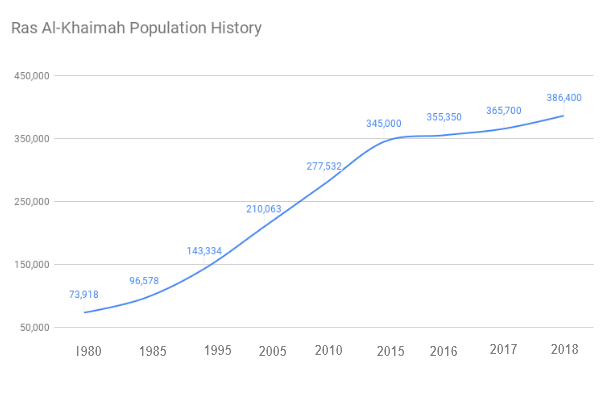
Population of Umm al-Quwain
Year |
Source |
Population |
| 1980 | Census | 12,426 |
| 1985 | Census | 19,285 |
| 1995 | Census | 35,361 |
| 2005 | Census | 49,159 |
| 2010 | Official Estimate |
65,000 |
| 2015 | *GMI Estimate |
66,570 |
| 2016 | *GMI Estimate |
68,140 |
| 2017 | *GMI Estimate |
71,279 |
| 2018 | *GMI Estimate |
77,558 |
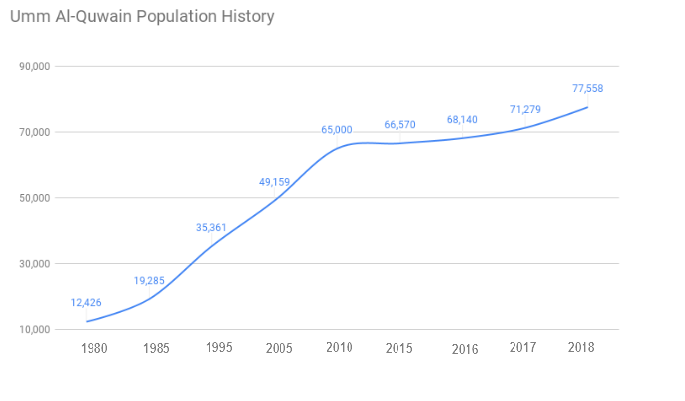
Located between Sharjah and Ras al-Khaimah, Umm al-Quwain has
the lowest population among all the Emirates in the UAE. This is
the only Emirate where women outnumber men. Fishing is the largest
contributor to the economy of Umm al-Quwain. The islands around
this Emirate make it a very important tourism destination.
THE POPULATION BOOM
Over the years, the country has gone through several key
demographic changes. The discovery of oil gave momentum to the
economy of the country. Recently, the UAE government has also been
promoting a tourism and knowledge-based economy to spur the
economic momentum. Today, Dubai ranks among the most visited cities
of the world, ranking 6th with 16 million visitors in 2017, as per
thisisinsider.com.
The increase in the number of jobs across sectors led to an
influx of workers at all levels of all nationalities. Within a span
of a decade, the total population grew by about 5 million. This
boom in population was largely due to the burgeoning expat and
immigrant population. UAE has the world’s highest net migration
rate, with nearly 88.52% of population composed of expatriates and
immigrants.
This becomes even more apparent when we look at the fertility
rate in the UAE. The average rate of babies born per fertile woman
has been showing a downward trend for the past decade, and yet the
population is soaring.
An in-depth analysis of the population of the UAE can help
marketers formulate plans, goals and strategies to promote their
brand. With more than 19 years of experience in the digital
landscape of the Middle East, GMI has crafted the digital presence
of some of the best brands in the region. We understand what it
takes to tap into your target audience on various digital
platforms. We can help ideate and weave a digital
strategy that works for your brand. Talk to our
digital strategists today and take your brand to the people
you want to reach.
Disclaimer: GMI acknowledges that though
we try to report accurately, we cannot verify the absolute facts of
everything that has been represented on this infographic. The
information represented is based on information researched from
various sources on the internet. We are not liable for any errors,
financial loss, or damages of any kind that may result from the use
of, or reliance on, the information herein.

Shuaib Welcomes Guests to CJA
Fani-Kayode’s Gaffe and the Rot in the Media, By Gidado
Shuaib
Of late, the Former Aviation Minister, Femi Fani-Kayode, has
come under heavy media flogging from various persons, journalism
unions and top columnists, condemning his attitude towards a Daily
Trust journalist, Eyo Charles, during a press conference.
Without attempting to belabour the issue, I wish to recall how
the incident happened as well as the attendant media backlash.
First, it is instructive to know that a press conference, in other
words, is a platform on which a journalist and newsmaker interact
through a question-and-answer parley. It is a form of drilling to
which a newsmaker is subjected for onward transmission to the
public.
However, Fani-Kayode, during one of such parleys, turned down a
journalist’s question and, as if that was not enough disservice to
the intent of the platform, this fellow had the effrontery to call
this benign journalist all sorts of names. Well, thanks to Social
Media. Fani-Kayode’s assault against the journalist would have been
history.
An archetypal precedent has long been set. Although, it was not
in our clime. At a press briefing in the White House last year, US
President Donald Trump used somewhat unprintable adjectives to
describe and ‘disparage’ the personalities of both the CNN and NBC
White House Correspondents.
Both Peter Alexander of the NBC and his CNN colleague, Jim
Acosta, were not spared the verbal ‘missile’ of the
utterly-rambunctious US Number One citizen.
Mr Trump repeatedly blasted the two US reporters, reminiscent of
the Femi Fani-Kayode and Eyo Charles’ ‘fiasco’ in Calabar
penultimate week.
Trump never minced words in telling the CNN reporter, at a
point: “You are very rude, and a terrible person. CNN should be
ashamed of having you as their reporter.”
As for Fani-Kayode, who is a self-acclaimed activist, his
reaction only exposed him as not being different from every other
person he condemns.
On the heels of the sad incident, one of the foremost Civil
Society Organisations in the country, Civil Society Legislative
Advocacy Centre (CISLAC), came out to unequivocally condemn
Fani-Kayode’s belligerent assault against the reporter, reiterating
that press freedom and freedom to do journalism could not be joked
with, especially at this time when COVID-19 had taken its toll on
the journalism practice.
“While we are not unaware of the Fani-Kayode’s regular
antagonistic reaction and response to issues, we uphold our
position that Press Freedom and journalism must be respected and
protected at all levels.
“We express total discomfort not only in thoughtless use of the
word “stupid” but also reported threat and intimidation of the
journalist during and after a press conference held in the
state.
“We also find the reaction of the Former Aviation Minister
worrisome and tantamount to silencing the media freedom; as he is
known to hitherto leverage the media in expressing a personal view
and opinion on issues without fear or intimidation,” CISLAC’s
Executive Director, Comrade Auwal Musa Rafsanjani, had said in a
statement.
Now, although Fani-Kayode has regretted and apologised for the
public gaffe—an afterthought anyway; what remains befuddling is the
fate of journalism in Nigeria. Remember that the journalist, after
the incident, had come out bruised and tattered. Nobody was saying
anything about him, not even a word of encouragement to make him
stay put in the course of objective journalism pursuit.
Sadly, we live in a society where journalists are constantly
killed, harassed and intimidated for doing their job, but little or
no care has been shown to address this rising menace.
It should be noted that most journalists in the country are
either unpaid or underpaid, leaving most of them to be bootlickers
of one politician or the other. Until media owners pay journalists
well and promptly, enforcing the ethics of the profession will
remain a major problem.
As at this moment, only a few publishers constantly pay what can
truly be described as a take-home package. Many Nigerians are now
discouraged from joining the profession, thereby now exploring
other sectors they find lucrative.
Recent reports have revealed that newsroom employment has
significantly decreased. The COVID-19 outbreak has also led to a
rapid scaling back of advertising spending, which has inadvertently
led dozens of newspapers to cut budgets and furloughs.
Similarly, a dozen media think-tanks in the country like the
Wole Soyinka Centre for Investigative Journalism, Enough is Enough,
International Press Centre, the International Centre for
Investigative Reporting, and Premium Times Centre for Investigative
Journalism had commissioned surveys, following perceptions that
journalists were being exposed to danger in the course of covering
the pandemic.
One of the surveys, filled by 463 journalists – correspondents,
reporters, editors, freelancers, and presenters from 73 print,
broadcast and online media across 33 states and the Federal Capital
Territory – revealed that there had been poor attention to the
needs, safety and welfare of journalists covering the pandemic.
Drawing from these responses, media proprietors were urged to
prioritize the welfare of their reporters.
The media, especially in Nigeria, and at this particular
juncture, must step up its game by doing everything necessary to
protect the inalienable rights and privileges of members of the
fourth estate in the country.
Against this backdrop, it is my humble submission that media
owners should come up with innovative ways to generate revenue for
their platforms as the present advertising model can no longer
work, in as much as such finances are needed to sustain the
business.
Also, as far as I am concerned, it will not sound too ambitious
for politicians and other elites in the country to emulate the best
practices of developed nations and begin treating journalists like
kings and not dregs.
Only then, will the media and Nigerian journalists take its
pride of place in the heart of the masses, and even become
society’s true watchdog.
Gidado Shuaib, a media researcher, is the editor of The News
Digest. He can be reached on [email protected][1]