
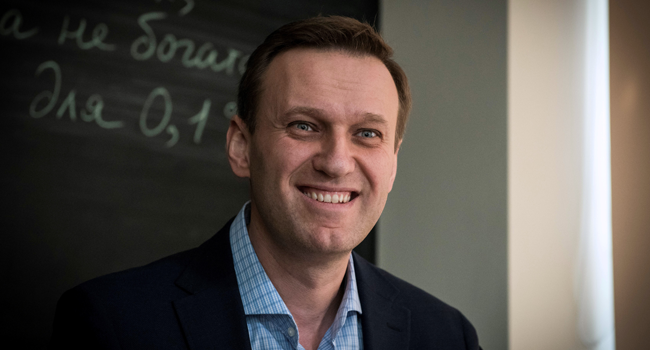
January 16, 2018 Russian opposition leader Alexei Navalny smiles
during an interview with AFP at the office of his Anti-corruption
Foundation (FBK) in Moscow. Mladen ANTONOV / AFP
Moscow said on Wednesday a “disinformation campaign”
over the alleged poisoning of opposition figure Alexei Navalny was
being used to promote new sanctions against Russia.
Moscow released a statement after the Group of Seven foreign
ministers demanded on Tuesday that Russia quickly find and
prosecute those behind Navalny’s suspected poisoning, which Germany
says was carried out with a Novichok nerve agent.
The “ongoing massive disinformation campaign” aims at
“mobilising sanctions sentiment” and has nothing to do with
Navalny’s health or “finding out the genuine reasons for his
hospitalisation”, the Russian foreign ministry said.
In its statement in response to the G7, the foreign ministry
also reiterated accusations that Germany, where Navalny was
evacuated, has been refusing to share its findings on his case with
Moscow.
“Unfounded attacks on Russia are continuing,” the ministry said,
with a “whipping up of hysteria” around the case.
(adsbygoogle = window.adsbygoogle || []).push({});
The top diplomats from the major industrial democracies said
that Germany briefed them with confirmation that President Vladimir
Putin’s leading critic was poisoned.
The statement was released by the United States and included
Secretary of State Mike Pompeo.
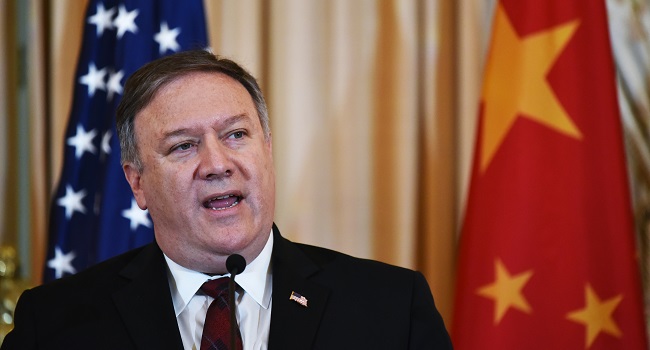
November 9, 2018 US Secretary of State Mike Pompeo speaks during a
press conference with Chinese politburo member Yang Jiechi and
Defense Minister Wei Fenghe during the US-China Diplomatic and
Security Dialogue in the Benjamin Franklin Room of the State
Department in Washington, DC. (Photo by MANDEL NGAN /
AFP)
The other G7 nations are Britain, Canada, France, Germany, Italy
and Japan. Russia was expelled from the then Group of Eight over
its 2014 takeover of Crimea from Ukraine.
Navalny, a 44-year-old lawyer who has been Putin’s leading
critic, suddenly fell seriously ill last month as he took a flight
in Siberia.
The Berlin hospital treating him said Monday that he was out of
a medically induced coma and reacting to speech.
AFP