
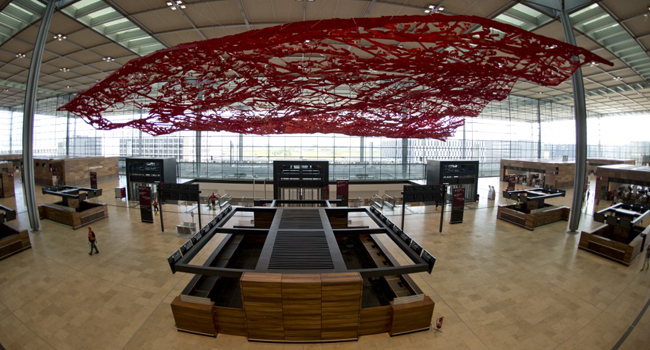
The Berlin region’s new international airport was
supposed to be a symbol of German unity and engineering prowess as
the country came together after nearly half a century
divided.
But instead, the new hub called BER — which will finally open on
Saturday after nine years of delays and technical failures — has
become an embarrassing dent in Germany’s reputation for
efficiency.
Here are key facts about the mishap-prone project.
Symbol of Reunification
After the fall of the Berlin Wall in 1989, city authorities
wanted a new airport to be a symbol of a country reunited after
decades of the Cold War.
Aside from the technical BER initials, the airport carries the
name of the former West German Chancellor Willy Brandt, who opened
relations with the eastern bloc in the early 1970s.
At reunification in 1990, the German capital had three
middle-ranking airports — Tegel and Tempelhof in the west and
Schoenefeld in the former communist east.
In 1996, local and national authorities began drawing up plans
for a new airport fit to rival international hubs such as Frankfurt
and Munich, with a planned opening date of 2011.
Tempelhof, known for its huge Nazi-era canopy, closed in 2008 —
the runways and airfield have since been converted into a massive
city park — while the other two airports remained in service.
Faults and Scandals
In 2010, the first signs of turbulence appeared. Project
managers said stricter European aviation safety regulations and the
bankruptcy of a planning company meant they had to delay the
opening by a year.
From then on, the opening was repeatedly postponed.
In 2012, construction was suddenly halted after a fire safety
system was found to be defective.
An inauguration ceremony planned only a few weeks later with
Chancellor Angela Merkel was hastily cancelled.
In 2016, things took a sinister turn when prosecutors
investigated the alleged poisoning of a whistleblower who had
called out corruption on the project.
Faulty lighting systems, escalators that were too short, not
enough space for lucrative shopping outlets… the project was dogged
by one issue after another.
Costs Take Off
The airport’s price tag had rocketed from 1.7 billion euros ($2
billion) to more than 6.5 billion euros ($7.6 billion) by 2020,
bringing an extra burden on a city already heavily in debt.
(adsbygoogle = window.adsbygoogle || []).push({});
Once popular former mayor Klaus Wowereit — who coined the “poor
but sexy” catchphrase that became Berlin’s moniker in the early
2000s — was one of the project’s most high-profile casualties.
As chairman of the airport’s supervisory board, he was blamed
for cost overruns and later resigned over what he considered his
“biggest failure” after 13 years in power.
Airport executives and local media began speaking of a “cursed”
project.
Local Opposition
In a referendum organised by locals in 2017, Berliners voted to
keep open Tegel, known for its unconventional hexagonal design and
ease of travel. Aircraft gates were just steps from the terminal
entrances but its facilities eventually became cramped and
outdated.
The vote highlighted the attachment Berliners have to the
airport, built-in 90 days with Europe’s longest runway in 1948 as
the Soviets blockaded road and rail into the western sector.
But authorities stuck to the plan and confirmed the closure of
Tegel for late 2020. The area will be converted into an office
park, with the terminal buildings forming part of a university for
applied sciences.
Opening in a Pandemic
The explosion of tourism and cheap flights of the last decade
caused authorities to think Berlin Brandenburg had been designed
too small.
The hub was to have a capacity of 27 million passengers a year,
increasing to 33 million with the opening of a second terminal a
few years later.
Yet in 2019, 35 million passed through Berlin’s two
airports.
Authorities decided that Schoenefeld, the unloved communist-era
airport next to the new site, will continue to operate as BER’s
Terminal 5.
At the end of 2019, project managers announced that the new
airport would finally open in 2020.
With aviation traffic into Berlin down 70 per cent this year due
to the coronavirus pandemic, at least capacity will be one less
thing for the operators to worry about.
Read more https://swordpress.com.ng/2020/10/28/what-you-need-to-know-about-berlins-cursed-new-airport/