
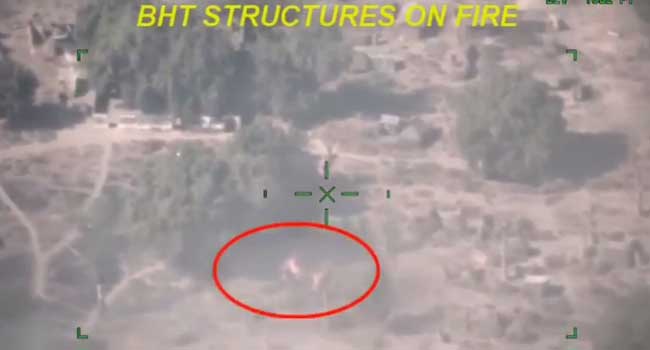
Air Force video clip showing military operations in Borno State.
Credit: Defence Headquarters.
The Air Task Force of Operation Lafiya Dole has killed
several Boko Haram terrorists in their hideouts at Kote Kura and
Bulama Isamari areas of Borno State.
This was disclosed in a statement issued on Sunday by the
Coordinator of Defence Media Operations, Major General John
Enenche.
“In continu ation of the series of Air Interdiction missions
being conducted to rid the North East of the Country of terrorist
elements, the Air Task Force of Operation LAFIYA DOLE has taken out
more Boko Haram Terrorists’ (BHTs’) hideouts and eliminated several
of their fighters at 2 locations – Kote Kura and Bulama Isamari –
both in Borno State,” the statement partly read.
(adsbygoogle = window.adsbygoogle || []).push({});
According to Enenche, the NAF attack aircraft engaged scores of
terrorists observed in the target area which led to the destruction
of their bases.
He said the operation followed credible intelligence that the
insurgents “had recently established camps at the two settlements,
where they store their logistics items as well as plan and launch
attacks.”
“In the same vein, at Bulama Isamari, within the Timbuktu
Traingle, the NAF aircraft took turns in engaging the target,
scoring accurate hits which equally resulted in the neutralisation
of several terrorists,” the defence spokesman added.
Read more https://swordpress.com.ng/2021/01/03/air-force-kills-several-boko-haram-terrorists-in-borno/

By Jeremiah Onaolapo

The power over exploration and exploitation of mineral resources
in Nigeria shall be vested in the government of the federation, in
this case, Nigeria. The legislative enactment giving this power is
the Nigeria Mineral and Mining Act of 2007 which repealed Mineral
and Mining Act of 1999.

It provides in S 1(1): the entire property in and control of
all mineral resources in, under or upon any land in Nigeria, its
contiguous continental shelf and all rivers, streams and by its
territorial waters or constituency and the Exclusive Economic Zone
(and area extending from the external limit of the territorial
waters of Nigeria up to a distance of 200 nautical miles from the
baseline from which the breath of the territory waters of Nigeria
is measured) is and shall be vested in the government of the
federation for and on behalf of the people of Nigeria.
The major purpose of the enactment is to regulate all aspect of
the exploration and exploitation of solid minerals in Nigeria and
for related purposes. Under the wings of the extant law, there is
an extension or a new development that gives valuable consideration
for possible sustainability of community where the mining operation
will be conducted. Note: this provision was not captured in the
Mineral and Mining Act of 1999. The title holder of a mining lease
and the community host are to conclude on behalf of the community
at large, on an agreement (Community Development Agreement) that
will ensure socio-economic development in that community.
Under the provision of the extant law, S 117
provides for the objectives of the agreement that the Community
Development Agreement shall specify appropriate consultative and
monitoring frameworks between the mineral titleholder and the host
community, and the means by which the community may participate in
planning, implementation, management and monitoring of activities
carried out under the Agreement.
Furthermore, in S 118 provides that every holder of mineral
title under the Mineral and Mining Act 2007 shall as far as it is
reasonably practicable-
- Minimize, mange, and mitigate any environmental impact
resulting from activities carried out under the Act; and - Rehabilitate and reclaim, where applicable, the land
disturbed, excavated, explored mined or covered with tailing
arising from mining operations to its natural or predetermined
state or to such state as may be specified in this Act, its
Regulation and other pertinent laws in force, and in accordance
with established best practices. - The Community Development Agreement
The provision Section 116 of The Mineral and Mining Act of 2007
is a newly enacted law that proffers a wide range of development
for the community and it provides as follows:
- Subject to the provision of this section, the holder of a
Mining lease, Small scale Mining lease or Quarry lease shall prior
to the commencement of any development activity within the lease
area, conclude with the host community where the operations are to
be conducted an agreement referred to as a Community Development
Agreement or other Agreement that will ensure the transfer of
social and economic benefits to the community. - The Community Development Agreement shall contain
undertakings with respect to the social and economic development
contributions that the project will make to the sustainability of
such community. - The Community Development Agreement shall address all or
some of the following issues when relevant to the host
community- - Educational sponsorship, apprenticeship, technical training
and employment opportunities for indigenes of the
communities; - Financial or other form of contributory support for
infrastructural development and maintenance such as education,
health or other community services, roads, water and
power; - Assistance with creation, development and support to small
scale and micro enterprises; - Agricultural product marketing; and
- Methods and procedures of environment and socio-economic
management and local government enhancement. - In the event of failure of the host community and the
lessee, after several attempts to conclude the Community
Development Agreement by the time the titleholder is ready to
commence development work on the lease area, the matter shall be
referred to the Minister for resolution. - The Community Development Agreement shall be subject to
review every 5 years and, shall until reviewed by the parties, have
binding effect on the parties.
The provision of this law is to address the optics of the
environment where there is operation and mining of the mineral
resources and to give a sustainable development that will ensure
social and economic growth of that community. The agreement shall
be subject to review every 5 years. It also seeks to ensure that as
resources are been exploited and explored, a commensurate
development plan or agreement is put in place, so that the
inhabitants and indigenes do not suffer by the mining
operation.
In conclusion, the provision of the Mineral and Mining Act of
2007 as against the Mineral and Mining Act of 1999 provides for the
development of the community socially and economically through the
involvement of the community host and lessee in settling the
agreement, participation of the indigenes and working towards
actualization of relevant development needed in the community as
provided in the extant law. Note that there can be liability for an
action to enforce the letters of the law in court where the
provision in the extant laws are violated, neglected or infringed.
The African Charter on Human and People’s right, Article 24
provides that “all people shall have the right to a general
satisfactory environment favorable to their development.”
Article 21 provides that “all people shall freely dispose of
their wealth and natural resources, this right shall be exercised
in the interest of the people. In no case shall the people be
deprived of it.” The provision makes the violation of the
extant law an infringement on the right of the people that are
concerned.
Written by Jeremiah Onaolapo, Abuja based
lawyer, 07064506533,
onaolapojeremiah28@gmail.com