
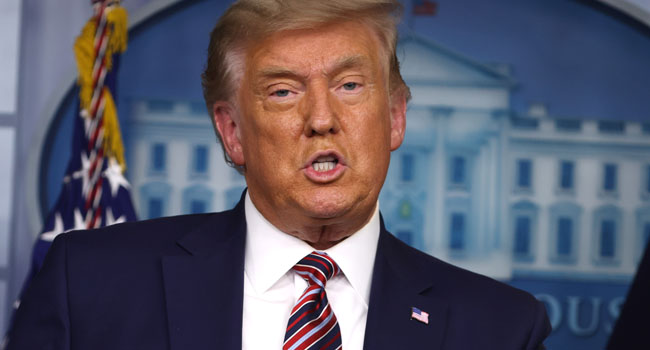
speaks to the press in the James Brady Press Briefing Room at the
White House on November 20, 2020 in Washington, DC. U.S. Tasos
Katopodis/Getty Images/AFP
Twitter’s decision to impose a permanent ban on US
President Donald Trump’s account has sparked some consternation in
Europe, with German Chancellor Angela Merkel calling it
“problematic”.
The move, prompted by fears of “further incitement of violence”
after last week’s attack on the US Capitol building that was partly
blamed on the US president, reignited debate over regulation of
social media.
Facebook, Instagram and Snapchat have all now issued their own
bans, triggering a flood of reactions from around the world.
European commissioner Thierry Breton, who has introduced two EU
proposals that would place more restraints on digital giants, saw
Twitter’s decision as a total break from the past, calling it “the
9/11 moment of social media” in an op-ed published by Politico.
swordpress.ng ojoojoo.com search: England Opens
Mass Vaccination Sites As COVID-19 Spike Fears Spread
US internet giants have often been accused of holding too much
power over social media, and many governments have called for them
to face more regulation.
Merkel’s spokesman Steffen Seibert said she “considers it
problematic that the accounts of the US president have been
permanently blocked”.
He added: “It is possible to intervene in the freedom of
expression, but in accordance with limits defined by the
legislator, and not through a decision by company management.”
– ‘Digital oligarchy’ –
French Economy and Finance Minister Bruno Le Maire agreed, telling
state-run France Inter radio: “The regulation of digital giants
cannot be done by the digital oligarchy itself.”
Russian opposition figure Alexei Navalny also denounced — on
Twitter — what he branded “an unacceptable act of censorship” based
on “emotion and personal political preferences”.
Digital law specialist Florence G’sell, who called Twitter’s
decision an “earthquake”, detailed a three-part plan on the part of
the European Union that she said “could be of great interest to the
Americans”.
The EU intends to set up a procedure for implementing moderation
decisions, a way to contest these decisions and the possibility of
resolving disputes through a third party, she told AFP, stressing
that legislation is needed on both sides of the Atlantic.
(adsbygoogle = window.adsbygoogle || []).push({});
“I think the platforms are ready to cooperate. But we mustn’t be
naive: there are enormous financial stakes. They have greatly
profited from the polarisation.”
US social media have regularly cited Section 230 of the US
Communications Decency Act when they claim to simply host accounts
but not bear responsibility for the content.
Transnational problem –
“The dogma anchored in section 230 — the U.S. legislation that
provides social media companies with immunity from civil liability
for content posted by their users — has collapsed,” Breton
wrote.
“It is a monument that has collapsed in the information space,”
he added in remarks to journalists Monday in French.
“For the first time in the history of social media, this act
acknowledges by those who are the main actors, that they have an
editorial responsibility,” he said.
Digital lawyer Christiane Feral-Schuh noted, for her part: “In
the United States, the First Amendment protects American citizens
against any infringement of their freedom of expression, but the
Supreme Court also considered that private actors could moderate
their discussion spaces as they wish.”
Nevertheless, what the platforms are doing is tantamount to
“censorship couched in (their) general conditions”, she told
AFP.
She warned that laws “will not be enough to resolve the
problem,” which she called “transnational”, and stressed the need
for due process when the platforms suspend accounts, remove posts
and so on. That is, citizens should be able to challenge them in
court.
It remains to be seen what the administration of US
President-elect Joe Biden will do after a highly charged Senate
hearing last November of the Facebook and Twitter founders over the
now famous “Section 230”.
Kate Ruane, senior legislative counsel for the American Civil
Liberties Union, said “it should concern everyone when companies
like Facebook and Twitter wield the unchecked power to remove
people from platforms that have become indispensable for the speech
of billions.”
AFP
Read more https://swordpress.com.ng/2021/01/12/twitters-problematic-trump-ban-troubles-europe/